Wednesday, October 23, 2024

TEETH (2007)


Worst. Gynecological. Exam. Ever.
 
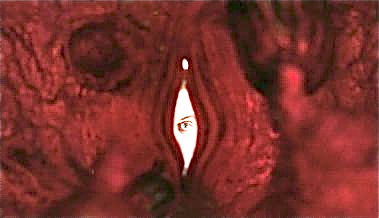
Perfectly striking the incredibly delicate balance between dark comedy and outright horror, TEETH has the look and feel of any garden variety teen coming of age comedy, with its narrative centered on Dawn (a winsome Jess Weixler), a sweet high school student who serves as a very vocal proponent for Christian pre-marital sexual abstinence. Living in the shadow of a twin-towered nuclear power plant, Dawn shares a house with her father, terminally-ill step-mom, and very creepy, obviously disturbed older step-brother, Brad (John Hensley). As adolescent biological urges wage war with Dawn's stance on abstinence, Dawn fails to recall an incident from her early childhood in which her already hateful soon-to-be step-brother (who's maybe five or six at the time) curiously tries to digitally probe her vagina while they're both in a kiddie pool, only to end up with the tip of the exploring finger getting mysteriously severed. It turns out that for whatever reason (my money's on the nearby nuclear plant), Dawn possess the literal "vagina dentata" of mythology, the teeth of which are described as being akin to those of a lamprey, and her self-imposed sexual repression keeps her toothy nether region in check. Unfortunately for Dawn, as she struggles with her utterly normal teenage desires, she runs afoul of a string of predatory, misogynistic peers and grown men who find themselves on the severing receiving end of her snapper's chomping defensive reaction, which leaves the sweet girl feeling horrible guilt while also considering herself and her budding adult sexuality as inhumanly monstrous.

TEETH is simultaneously funny, horrific, and unsettling in what it has to say about how society treats women by means of infantilization and repression of their sexuality and the autonomous control thereof, as well as male domination of women's bodies and the maintaining of a casual rapist mentality of the entitled oppressor. The narrative paints a very negative picture of the male in general society  — virtually every guy in the film sexually abuses Dawn, with the notable exception of her dad — and has been railed against by some as a flagrant piece of misandry-laden femi-nazi propaganda, but I don't see it that way at all. The story is clearly intended to be a very dark comedy that tackles some very tough subjects while addressing long-held cultural taboos about all things vagina-related, and the men in the story have to be verminous creeps in order for its impact to succeed. And though her Cronenbergian "body horror" may lead some to consider her a monster, Dawn is anything but horrific and she is quite likable, which only makes the audience care for her all the more and want to see her arrive at some kind of peace with her literally mythic pussy. 

TEETH is right up there with BAD BIOLOGY as a modern comedic examination of fear wrought by our own genitalia, and is by far the better-crafted of the two. I recommend it in general, but most especially for women who have a sense of twisted humor when it comes to their own girly bits.


Poster for the original theatrical release.

VILLAGE OF THE DAMNED (1960)


There are certain films that could ostensibly be classified as part of the science-fiction genre and yet cross over full-blown into the horror department — ALIEN (1979) being a textbook example — and the original VILLAGE OF THE DAMNED sure as hell fits the criteria. For sixteen years before THE OMEN pretty much cornered the market when it came to the "creepy kids" sub-genre, VILLAGE OF THE DAMNED stood as the ne plus ultra of the form and if you ask me, it still has yet to be bested.

Based on legendary British horror/sci-fi author John Wyndham's novel THE MIDWICH CUCKOOS (1957), the film matter-of-factly chronicles the events spiraling outward from a day when several locations on the Earth are suddenly cut off by an invisible field that renders living beings unconscious for several hours, after which all wake up, apparently none the worse for the experience. Fine, whatever. But things take a very disturbing and dark turn when every woman in town who's capable of bearing children inexplicably turns up pregnant, and the story proper follows how this scenario plays out in the rural British village of Midwich. While there are cases where the unexpected pregnancies are treated as nothing out of the ordinary in the case of married couples, it's another matter entirely for wives who have been separated from their husbands for long stretches of time (one such case involves a husband who's been away at sea) and the poor young teenage girls who have never known the grownup pleasures to be had with boys their own age, let alone grown men. While such a situation may have worked out well for the Virgin Mary, it holds an horrific power that's the polar opposite of the miraculous when it happens en masse in the mid-20th century.

All of this leads to considerable misery and suspicion, but it's soon determined that all of the pregnancies can be tracked to having been conceived during the time of the village's unexplained mass-unconsciousness. The sole couple who are shown to be at first overjoyed by this happenstance is comprised of late-middle-aged professorial type Gordon Zellaby (George Sanders) and his much younger wife, Anthea (Barbara Shelley), who had both given up hope of ever having a child due to Gordon's age, but that elation soon turns to a growing sense of dread once their child and all of the others are born on the same day, after developing much more rapidly than average embryos. The children all possess a disturbing uniform look, each having "striking" eyes, "unusual" fingernails, and nearly-white blonde hair, but the most disturbing thing about them is that they manifest powerful telepathic abilities and the ability to control the minds and actions of those who displease them (which is an incredibly dangerous trait for infants to wield). The emotionless kids also share a hive mind that allows what one learns to be absorbed by all. Needless to say, that's all pretty fucking creepy, and as the children grow to the physical equivalent of perhaps age seven or eight, virtually the entire town is understandably terrified of them. Only professor Zellaby wants anything to do with them, motivated by his "parental" connection to his eerie son and leader of the kids, David (Martin Stephens), and by his overwhelming scientific curiosity. As the children's powers escalate, so does their detachment from and disregard for the lives of those around them, and their mind-controlling abilities lead to a number of horrifying, decidedly one-sided confrontations with the village's adults. But when faced with a gaggle of kids who can literally make you blow your own head off with a double-barreled shotgun, a "time out" just isn't gonna do it...

So where did these cold, creepy children come from? Why are they here? What in god's name will happen to the world when they are fully grown? And don't forget that they are just one of a number of groups of these kids born around the world...

A solid, taut winner from start to finish, VILLAGE OF THE DAMNED has been one of my all-time favorites since I was a kid, and I'm happy to say that it holds up perfectly well. (I just watched it again four nights ago.) The 1995 American-set remake is okay for what it is, but the black and white look of the original and its remote, rustic British location make for a timeless shocker that also depicts its events with great, almost clinical intelligence. If you only see one "creepy kids" movie in your lifetime, this is the one I most heartily recommend.

Original theatrical release poster.

ADDENDUM, 2017:

From the 2014 Chiller Theatre convention.

At the 2014 Chiller Theatre convention, with Martin Stephens.

ED GEIN (2001)

Steve Railsback as Ed Gein: NOT the most well-adjusted of folks...(Gein, not Railsback.)

Edward Theodore Gein...Where would the horror genre of just over the last fifty years be without him unleashing all-too-real nightmares upon an unsuspecting Plainfield, Wisconsin in the 1950's? Norman Bates, Leatherface, and Jame "Buffalo Bill" Gumb all crawled forth from the minds of their creators after being inspired by Gein's crimes, and some would say that the genesis of those fictional murderers was something of an attempt to come to grips with what the unassuming town weirdo got up to back in the days. That's as may be, but I say it's damn near impossible to come up with any fiction that's anywhere near as mind-fucking as the real thing, and you can damned well be sure that the America of the supposedly idyllic Fifties was not ready for what was found in Ed's squalid home and shed. Since that hideous discovery, Ed Gein has crossed over into the most dire annals of Americana, becoming in the popular consciousness a bogeyman of a ghoulish ilk that far surpasses the tales of "the Hook" that have scared kids around campfires for ages.

While not 100% accurate to the facts, this filmic retelling of Gein's story focuses mainly on the events leading up to his murder of shopkeeper Bernice Worden in November of 1957, interspersed with flashbacks from his childhood through his adult years, during which time we see his fragile, sensitive mind and soul crushed under the heel of his clearly psychotic religious fanatic of a mother, a harridan who guilt-tripped the lad with her misrepresentation of the Good Book and a rabid denouncing of anything that was healthily sex-related as evil and sinful. Growing up in such an environment would not be easy on anyone, but poor Ed was doomed from the very start, his mind warped by his mother's influence and constantly at war with his own confused sexual urges. By the time he reached middle age, Ed was a fucking mess — to put it in the mildest possible terms — and when his mother inevitably gave up the ghost, he was lost without her and took care to board up his her rooms in the house they shared, leaving them perfectly preserved while the rest of the place was reportedly a study in clutter and filth. 

Considered something of a town weirdo, though deemed by most to be a harmless eccentric, Gein did odd jobs for the citizens of Plainfield but his oddest of jobs were his nocturnal..."hobbies," which included digging up the graves of women and collecting parts of their bodies, which he put to use for a number of grisly "handicrafts." Spurred by his deeply twisted sexual yearnings, Ed would fantasize about changing his gender and even crafted a crude "woman suit" from the skins of his exhumed prizes, in order to facilitate the most horrific form of transvestism imaginable. 

"♫ Mystery Date...Are you ready for your Mystery date??? ♬"...No. No, you are NOT.

Gein was always (rightly) perceived as strange, but his unnerving behavior came to a head when he shot and killed Bernice Worden and took her body out to his shed, where he hung her naked, beheaded carcass upside down from the rafters and eviscerated her like one would do to a freshly-hunted deer. When her blood was discovered on the floor of the store where she worked and a sales slip with Ed's signature on it was found, the police went round to Gein's place to question him and unwittingly stumbled into a tableaux that no doubt sent them to voiding the contents of their stomachs all over the gravel outside. Upon searching Gein's house, the unfortunates tasked with the investigation came up with a laundry list of fucked-up shit, including a belt made from nipples, a box containing a number of excised vulvas, "shrunken heads" and "masks" crafted from the skins of corpses, bowls made from human skulls, indications of possible cannibalism...

Gein also confessed to the 1954 murder of Mary Hogan, a tavern proprietress, which brought his official murder total up to two — so he cannot be technically considered a serial killer; you need three or more to rate that classification — but you know the situation is beyond dire when the murder of two innocent women barely registers when stacked against the evidence of his other incredibly ghoulish acts. When all was said and done, Ed Gein was deemed mentally incompetent — Gee, ya think? — and sent to the Central State Hospital for the Criminally Insane and later transferred to the Mendota State Hospital (both located in Wisconsin), spending the remainder of his life in the latter institution, where he died or respiratory failure at the age of 77 in July of 1984. Thus did a pitiful, demented loner enter the annals of history and the darker recesses of pop culture.

The movie alters or condenses a number of the facts of Gein's case, but for the most part what it depicts gives the casual viewer a decent Crib Notes version that works effectively as a straightforward and very creepy horror narrative, albeit one with its roots very firmly embedded in fact. Steve Railsback is quite solid as Gein and adds the poor, tortured ghoul to his short roster of re-enacted madmen, right next to his chilling portrayal of Charles Manson in the made-for-television HELTER SKELTER (1976). He's the glue that holds together what could easily have been just a lurid parade of disgusting necro-degradations, and one even finds it possible to feel sorry for poor Ed because it's obvious that he could have had a chance if only he'd ripped himself free of his mother's warped clutches.

ED GEIN is definitely worth watching and it holds the viewer riveted as the twisted, stomach-churning  madness escalates. That said, it's only fair to warn some of this blog's more sensitive readers that the film derives considerable power from its audience knowing that the majority of what's seen in the movie actually happened nearly six decades ago, and unlike the legend of Sawney Beane and his Scottish clan of inbred, cave-dwelling, cannibalistic mass-murderers, photographs documenting the beyond-nauseating evidence of Gein's work exist...

BLOODSUCKING FREAKS (1976)

Trepanation by power tool, serving as a flesh-crawling preamble to oral exsanguination with a glass straw. Just one of the anti-charms vomited up by this filmic equivalent to having the grubbiest bum you've ever seen stick his filthiest finger past your epiglottis.

When one was becoming a budding gorehound in the early 1980's, there were certain movies that formed the short list of (supposedly) required viewing so that one could have an informed opinion when entering the general dialogue on the genre of gore-for-gore's-sake cinema with its more seasoned/hardened supporters. The primitive and genuinely awful — though nonetheless seminal and historically important — works of Herschel Gordon Lewis, George A. Romero's DAWN OF THE DEAD, and William Lustig's MANIAC all served to separate the men from the boys and varied widely in actual cinematic worth, with Romero's zombie effort far and away standing as the best and most deservedly celebrated of the lot. There were a number of others, but perhaps the most infamous was a rock-bottom, ultra-sleazy little number from 1976 entitled THE INCREDIBLE TORTURE SHOW, which was later obtained by a young Troma Entertainment and re-titled BLOODSUCKING FREAKS before once more being launched at the (relatively) innocent grindhouse audience sometime around or shortly after 1980 (information is sparse and/or unverified). Packed wall-to-wall with nudity, misogynistic slavery, heinous torture, cannibalism, a woman's naked ass being used as a dartboard (you can guess where the bullseye is), necrophiliac oral sodomy and all manner of sadism and general cruelty, it's a would-be-humorous exercise in unpleasantness that has much in common with the look and tone of most gut-bucket pornographic efforts from the 1970's. You know the kind I mean, those cheap loops that only the most sad and sorry of basement-dwelling desperadoes would hold in any kind of passable regard. The kind where all of the women in them were likely junkies and/or teenage runaways/prostitutes. It's a work of grubby entertainment at its lowest, and I found the whole experience both profoundly depressing and leaving me with the urge to immediately take a very hot shower where I scrubbed my every millimeter with industrial steel wool. The film's story is merely an excuse to depict as much sordid shit as the grindhouse audience of the mid-1970's could stomach, and if you're a student of that era's grindhouse fare you know that they could stand a hell of a lot. 

In a filthy mid-1970's NYC like that depicted in Martin Scorsese's classic TAXI DRIVER, there's an off-off-off-Broadway theater that runs a latter-day Grand Guignol-esque live S&M torture show, in which Master Sardu (Seamus O'Brien) and his eternally grinning dwarf assistant, Ralphus (occasional porn actor Luis De Jesus, who worked with Annie Sprinkle), abuse the fuck out of naked women they've kidnapped off the street and brainwashed into submission as slaves. Though the jaded audience believes they're watching some sort of ultra-gory stage magic display, what they're witnessing is real, live, to-the-death torture, sexual assault and mutilation. On the night that sets the paper-thin narrative in motion, the show is attended by snooty theater critic Creasy Silo (Alan Dellay), Joe Namath parody Tom Maverick (Niles McMaster), and his girlfriend, famed ballerina Natasha di Natalie (Viju Krem), and Sardu pulls out all the stops in hope of getting a glowing review from Silo. He also covets the participation of Natasha in his own twisted version of a ballet performance, so he kidnaps her and begins the brainwashing treatment, which attracts the investigative attentions of Maverick and an obnoxious detective (Dan Fauci). With all of that in place, the rest of the movie is a catalogue of extremely distasteful gore and sadism that simply isn't any fun, nor is it in any way scary. It's just sick for the sake of being sick, though I have to give the film credit for its creative (though utterly horrible) bit where a a doctor (Ernie Pysher) whom Sardu employs to care for his naked, feral slaves straps a blonde victim to a chair, chisels out her front teeth and pleasures himself with her bloody and battered mouth, after which he shaves her head, bores a hole into her skull with a power drill, and cheerily slurps her pulped brains up through a glass straw. There's also the aforementioned heartwarming scene of Ralphus jerking off with a severed head, so we're clearly talking family entertainment here, folks.

The utterly repellent Ralphus (Luis De Jesus), one of the vilest henchmen in cinema history.

The film's delirious climax is ludicrous to the point of hilarity as the brainwashed Natasha, now topless and sporting what are apparently solid iron ballet pointe shoes, stomps the kidnapped theater critic to death for his refusal to grant Sardu any critical kindness, while the feral nekkid chicks escape from their cage and devour Sardu, Ralphus, and the detective (and a few other random folks).

Long a favorite of bored, thrill-hungry high-schoolers and college kids, BLOODSUCKING FREAKS shared the dubious top spot in that province of sadistic gore films with the reprehensible cult "classic" ILSA, SHE WOLF OF THE S.S. (1975) until the advent of much better over-the-top viscera-strewn shockers like RE-ANIMATOR (1985) and BAD TASTE (1987), and today amounts to little more than a gross little curiosity. I don't know if one's gorehound cred still requires mandatory watching of this wretched load of swill, but if it doesn't, skip this and watch something better instead. In other words, just about anything else.

The now-infamous re-release poster.

NIGHT OF THE LIVING DEAD (1968)

 "They're coming to get you, Barbara!" And they were...

A true classic whose importance to horror cinema and culture cannot be overstated, the original NIGHT OF THE LIVING DEAD reigned for a long time as one of the scariest movies ever made, but today it may seem rather quaint to audiences jaded by the far gorier zombie apocalypse offerings that came in its wake, and that's a goddamned shame. When first released upon an unsuspecting public back in October of 1968, at first glance it looked no different from any of the legion of innocuous, time-wasting low-budget black & white shockers that populated local grindhouses and drive-ins across America, but in no time its grimmer-than-grim and then quite graphic content was traumatizing attendees of kiddie matinees and shocking audiences used to more genteel fare. Genteel this movie sure as hell ain't.

As a bona fide "monster kid" who'd devoured horror movies since I was three or four and religiously read FAMOUS MONSTERS OF FILMLAND and books on the subject like the most fervent of Talmudic scholars, I had heard of NIGHT OF THE LIVING DEAD mentioned as "the most horrifying movie ever made" and was aware of its zombies being clearly depicted in the act of consuming human flesh, so I longed to see it but never got the opportunity during my early childhood. Bitter over never getting to see it on any of the local NYC syndicated TV stations' horror movie showcases, I figured all the hype was probably just another come-on to lure the gullible and fleece them of the admission price, but my chance finally came when I was around twelve or thirteen and I was alone in the house on a stormy Saturday night. The local listings noted that the film would be on at 11:30pm on Channel 7, so I made myself some popcorn, turned off the light in my room, and turned on my black & white TV to the channel in question. Over the next two hours (including commercials), I was treated to what was up to that point the most relentlessly intense horror film I'd ever seen, and it frankly scared the shit out of me. And you know the film bore considerable power when even the periodic commercial breaks didn't douse the tension.

The story is simplicity itself: seven people end up trapped inside a remote, abandoned house somewhere in the vicinity of Pittsburgh, Pennsylvania as an unexplained invasion of slow-moving zombies surround the place. In short order they realize that there's little hope of escape or rescue from the siege of the undead, so they defend themselves with fire and limited weapons while crudely fortifying the windows and doors with bits of scrap plywood. They receive emergency TV news broadcasts that shed little light on the situation, but the reports state that the dead are rising all over the place and the only way to stop them is to burn them or shoot them in the head. ("Kill the brain, kill the ghoul.") And as if putting up a feeble defense against an ever-growing swarm of ravenous revenant flesh-eaters weren't bad enough, the trapped strangers must also contend with their mistrust and great dislike of one another. By the time it's all over, nobody wins and the ostensible hero (Duane Jones) meets an incredibly ignoble and ironic fate, which leaves the viewer utterly devastated and stranded in a world of doom and utter despair.

In retrospect I was glad I did not see the film any earlier than my tweens, because I knew in no uncertain terms that I simply could not have handled it while in the single digits. Watching the movie on a dinky black & white TV set only added to the experience, especially during the section where the characters watch the news reports; it felt like I was right there in the house with them, even when Channel 7 ran a title across the news segments that read "A Simulation." 

Now a firm supporter of NIGHT OF THE LIVING DEAD and its director and co-writer, George Romero, I kept my eyes open for a showing of the film where it would be completely uncut and projected, and it eventually turned up at the local youth center as a cheap show for Westport's tweeners who were (mostly) too young to have yet discovered the joys of stolen booze, pilfered weed and prescription drugs, and the physical fun that could lead to sweaty, backseat conceptions. The uncut version was even more of a revelation, with the brief gut-munching now being unmissable, as was the then-shocking presence of blank-faced nude zombies (that presumably wandered in from a local morgue or medical school). The implacability of the growing zombie horde was also much more effective when seen large, and the stark monochrome imagery read like some horrible latter-day E.C. Comics story, only written from a totally adult sensibility. The film is completely lacking in humor — excepting the famous "They're coming to get you, Barbara" scene, which almost immediately negates its dark levity with the arrival of the first zombie that unexpectedly attacks the Barbara in question — and its bleakness totally affected myself and the other kids who truly lost our horror cherries to Romero's instant classic. Sure, we'd seen horror movies for years prior to NIGHT OF THE LIVING DEAD, but for most of us it was that first life-changing moment when the scares were genuine, and from that there was no turning back to the almost corny weekly monster-fests that fired our imaginations as children. With NIGHT OF THE LIVING DEAD, horror finally got real for Americans and bared its teeth like the gloriously nasty beast we always expected it could be. (The same could be said of the impact of PSYCHO in 1960, but that's one of those scary films that walks the fine line between the thriller and the outright horror film, while there was no such ambiguity about what Romero had wrought.)

NIGHT OF THE LIVING DEAD unintentionally gave birth to the zombie genre as we now know it, and while its descendants, several of them made by Romero, may bring more in terms of budget, action and graphic gory content, none of them can match the film that started it all as a feature-length journey to an inescapable Hell on earth. If you've never seen it, it's readily available and dirt-cheap, so watch it with a big bowl of buttered popcorn and make sure the lights are all turned off...

BAD BIOLOGY (2008)

A view from the inside...of Jennifer.

I was born with seven clits. Seven that I know of, seven I that can feel and touch. Seven separate clitorises, each one constantly craving attention. Actually, I'm pretty sure that there are more than seven,  but the others are buried so deep inside that only a doctor could find them. And I'm sick of doctors. Doctors probing, doctors touching...Doctors, doctors, doctors...To some, I was a perfect example of permanent sexual arousal syndrome, but to most I was simply the girl with the crazy pussy.
-Jennifer, BAD BIOLOGY'S protagonist.

With an opening monologue like that, there was no way in hell that I wouldn't include this film in this year's review series!

From the twisted mind of Frank Henenlotter, the man behind the cult grindhouse classic BASKET CASE (1982), comes this story that reads like what might occur if H.P. Lovecraft went on a four-day tequila and Jaegermeister bender and attempted to write a porno movie. While not actually visually pornographic in the strictest definition of the term, BAD BIOLOGY pulls no punches when addressing the grottier aspects of human sexual function as they might work in cases of extreme and repellent deviations from the physical norm. It's Cronenbergian "body horror" with a pitch black, borderline John Waters-esque sense of humor.

Blonde, attractive Jennifer (Charlee Danielson) is a photographer who aggressively and artfully documents her dark, weird vision of sexuality, a vision that stems from her own...curious condition. You see, Jennifer is some sort of mutant whose difference involves her utterly bizarro genitalia and reproductive capabilities. Having begun menstruating at the age of five and cursed with seven known clitorises (there may be more within her somewhere) that make her perpetually horny and insatiable, Jennifer sees herself as her own species, "a new species. The doctors think I'm a genetic mistake, but I believe I'm an evolutionary leap forward, a female of the future who feeds on orgasms the way you people devour burgers and fries." Her unquenchable need leads her out at night to prey upon assorted thuggish lowlives in bars and dodgy pool halls and drag the unwitting studs back to their places, where she proves to be a thrashingly animated lover who demands her lovers cum insider her and whose inhuman throes of sexual ecstasy occasionally result in her killing her partners (whose corpses she photographically documents). After a typical fatal tryst, Jennifer immediately consumes large quantities of food before retreating to the nearest available bathtub or other private spot where she gives birth to full-term babies less than two hours after conception, then abandons the squalling infants wherever she births them, caring nothing for them because she's sees them as "fake, unfinished freak babies" since "real" babies take nine months to happen. All of this information is imparted within the film's first fourteen minutes, and things only intensify from there.

The masculine flipside to this is Batz (Anthony Sneed), a young man who is a virtual recluse whose isolation is due to his massive, perpetually horny and disturbingly sentient and drug-addicted penis. The Johnson in question got the way it is due to the thing having been accidentally amputated at birth (Batz states that he was never told exactly how that happened), but it was sewn back on and unfortunately completely lacked erectile capability. Since "no parent was gonna pay good money so their son could get a hard-on," the tortured teen began working out and obtaining steroids and growth hormones that he administered directly into his dick, resulting in his unit's very lively and independent attitude. In a pathetic attempt to maintain some semblance of control over his literally rampant member, Batz chokes his system with all manner of dangerous drugs — animal steroids and worse — and tries to satisfy his cock's needs with a jack-off machine that would make Rube Goldberg proud, and the results are not at all good. Needless to say, it's only a matter of time until these two sexual mutants meet, but before that happens they must weather a couple of majorly twisted sub-plots involving odd "art" porno, the disposal of the most inhumanly orgasmic and likely brain-damaged porn actress you've ever seen, and a literal cock on the loose...

BAD BIOLOGY is by no means flawless — none of Henenlotter's films are — but it tackles some very delicate and potentially offensive material with its tongue planted very much in cheek, and its extremely prurient content is especially tragi-comic to those in the audience who enjoy romance and fun sex that makes the participants feel good both physically and emotionally. The plights of Jennifer and Batz are quite miserable and viewers will want to see them connect and find some measure of relief and comfort in each other, but comedy though it may be, BAD BIOLOGY is still quite horrifying at its heart, and it never forgets that for even one minute. I dig it but there are those who might find it a bit too much to take, so carefully consider your own limits for this kind of thing before checking it out. A date movie it ain't, unless you and your squeeze find tormented mutant genitals to be a major turn-on.

THE OMEN (1976)


After the massive kick to the head that was 1973's THE EXORCIST, the public just couldn't get enough of devil junk and the inevitable diarrhetic spewing of low-budget cash-in/ripoff movies splashed loose, stinky satanic turds across the movie screens of the world. But while the knockoffs certainly provided fodder for undemanding grindhouse patrons and drive-in gropers, it was only a matter of time until a major Hollywood studio entered the fray and once more restored big-budget Satan to the big screen where he belonged. Enter THE OMEN, the Bicentennial year's contribution to the genre and the introduction of Damien, the deceptively cherubic-looking soon-to-be archetype of the cinematic depiction of the anti-Christ/evil child.

The basic story details the birth and early childhood of Damien Thorn (Harvey Spencer Stephens), the adorable son of U.S. ambassador to England, Robert Thorn (Gregory Peck), and from the get-go the audience is aware that the five-year-old lad is none other than the bona fide son of the Devil (born of a jackal and not a woman, thereby making Damien a very literal son of a bitch). The story really doesn't have much to it other than an ongoing series of "accidents" and gruesome deaths that are all related to Damien, as well as the ambassador's slow and grudging realization that his kid is the anti-Christ, and when one really gets right down to it, the movie is nothing without its shock set pieces. The characters are uniformly impossible to care about and all of the film's elements come off as a veritable laundry list of devil movie cliches that lead to it ending up as an unintentional spoof of the sub-genre's over-the-top tropes. So much so, in fact, that while watching THE OMEN for the first time in well over twenty years, I found myself giggling through much of its running time. Everything about the film — and I do mean everything — is over-wrought to the point of utter ridiculousness, and it's that heavy-handedness throughout that undoes the narrative and eventually sees it collapse into worn-out boredom by the final reel. Among the now de rigueur devil junk tropes that pack this flick are:

  • The gruesome deaths of those who get to close to or would interfere with the evil presence's agenda. Often these deaths are the most interesting aspect of this type of film, and that's definitely the case with this one, especially when nosy photographer David Warner is memorably decapitated by a large pane of glass.
  • Demonic Rottweilers.
  • The creepy nanny/caretaker who's an obvious minion of Satan.
  • Wall-to-wall "ominous" Latin choruses in the film's score. When over-used, as is the case here, this element becomes eye-rollingly laughable.
  • The seemingly-crazed Catholic priest who knows what's up and must therefore meet a horrible demise.
  • The cute demonic child who seldom, if ever, says a word and stares ominously at the camera.
There are more, but you get the idea.

So what we get with THE OMEN is a so-called classic that may have been quite a shocker when originally released, but now it's become a an over-rated, nearly-two-hour stale joke that gets old quick and fizzles out by its non-climax (there were two direct sequels). I suppose the film is so beloved and considered a classic because it was the first devil junk effort to come in the wake of THE EXORCIST that was at all competent, thanks largely to it having a big budget and name talent involved, and the public's hunger for more satanic thrills may factor into the kindness afforded to it. But with that said, THE OMEN doesn't stand a chance in, well, Hell when objectively compared against the excellence that was evident in every frame of THE EXORCIST. THE EXORCIST was propelled by a solid, character-driven story that engaged the viewer on e deeply emotional level, while THE OMEN's charms are akin to what one might have found in a better-than-average issue of CHAMBER OF CHILLS. Perhaps it's unfair of me to even attempt to measure the relative merits of one as opposed to the other, but I call 'em like I see 'em and to my way of thinking THE OMEN is nothing more than a catalog of cheap thrills that doesn't even have the benefit of being either the least bit suspenseful or actually scary. It's worth sitting through once, but it's grossly overrated and, once seen in its entirety, quite easily relegated to the realm of "been there, done that." I defy you to say the same of THE EXORCIST.

THE EXORCIST (1973)

The infamous scene that somehow did not thwart my interest in all things vagina-related.

What more can really be said about THE EXORCIST? It's arguably the most influential horror movie ever made and its plot particulars are so well-known that they have become a part of our common international culture and the subject of countless parodies and punchlines, so it's pretty much impossible to approach it cold and have no knowledge whatsoever of elements. Let's just call a spade a spade and state the case for exactly what it is: THE EXORCIST is the carved-in-stone epitome of the '70's-era "devil junk" movie, and it stands head and shoulders above what came before and after it simply by virtue of it being a beautifully crafted film from top to bottom. (For those who may have only just emerged from living deep within a cavern somewhere for the past four decades, THE EXORCIST is about the utter shitstorm that occurs when an innocent young girl is possessed by a malevolent demon for no apparent reason. You may now proceed to the rest of this post.)

I was eight years old when the film was unleashed upon an unsuspecting moviegoing public and it would be roughly another six years before I saw it for myself (in the heavily-edited version that premiered on CBS during my ninth grade year), but its impact was positively thermo-nuclear. All of my friends' parents saw it during that original run and its content was the subject of much discussion at the posh cocktail parties of Westport, Connecticut, content whose ultra-lurid descriptions were overheard and disbelievingly pondered by us eavesdropping kids who were supposed to be upstairs and asleep. A little girl who curses like a longshoreman, pisses on the living room rug during a party thrown by her actress mother and projectile vomits thick pea soup, only to top that by savagely jamming a cross up her underage pussy and screaming "LET JESUS FUCK YOU!!!" could not possibly be something they'd show in a movie theater, could it? Oh, it certainly could, and what made all of that possession-fueled mayhem even stronger was that it was starkly presented in a manner that was rooted in a reality that we all recognized and existed in on a daily basis. Sure, the possessed kid spoke with a demonic vocal timbre and could spin her head around like a fucking barn owl, but at no time was it accented with cheesy "spooky" music or overt depictions of Hell, plus the Catholic priest who first encounters the possessed girl is himself having a very deep crisis of faith, which only serves to underscore the unimaginable horror of what's transpiring. In short, THE EXORCIST took both itself and its audience seriously and presented its horrors with an up-front respect for the grownup viewer's intelligence (and possible theological cynicism or outright non-belief).

However, one of the biggest hurdles THE EXORCIST must overcome, both nearly forty years ago and today, is that its efficacy has a lot to do with the viewer's stance on Christianity in general and Catholicism in particular. I've found that the film's staunchest supporters were raised within the catholic church, and several of my Italian friends just fucking love it to death. In the case of my brother in all but blood, Greaseball Johnny, (who hails from Commack, Long Island), his doting and horror-loving Eye-talian grandmother took him to see it when it came out. Johnny was all of five years old at the time, so you would be right to assume that it left a rather sizable impression on him. (It remains his #1 favorite horror movie to this day, which is really saying something because  the guy's interest in the cinema of horror at times eclipses my own.) As for me, the edited version that I first sat through entertained me, but shorn of its harsh language and R-rated visceral shocks and with me firmly having had no belief or interest in organized religion since my earliest days of being forced to unwillingly endure the weekly spiritual drudgery/imprisonment that was Sunday school, it left me wondering what the big deal was. Without something resembling a belief in the Bible and the capital G "God," fully getting behind THE EXORCIST's faith-dependent narrative can be tough going (plus, to say nothing of having first encountered it in a neutered edition), and even after I finally saw it uncut I still did not grasp why the film was so universally beloved as a horror masterpiece.

The turnaround of my opinion finally came with the film's sold-out 20th anniversary screening at Radio City Music Hall, which I and several of my movie-loving friends attended. The audience was positively electric with energy as director William Friedkin and star Ellen Burstyn spoke about the movie and its impact, and that energy only built when the lights dimmed and the film splashed across the screen. When wee and wholesomely apple-cheeked Linda Blair's innocent mucking around with a Ouija board in the attic led to an encounter with the disembodied spirit identified as "Captain Howdy," nearly everyone seated in that theater let out a knowing and ominous "Ooooooooooooooooh," and from then on every shocking bit of supernaturally-spurred mishegoss elicited gasps and screams, finally culminating in an exhausted sense of catharsis as the demon is cast out, the girl is freed with no memory of what she's been through, and the attending priests both meet dire fates. Thus it was that I finally realized THE EXORCIST is a film best seen with a full house of those who truly grok its considerable power. It's an "audience movie" to the nth degree, so if you have the opportunity to see it projected in a theater, don't miss it.

It should also be mentioned that the international success of THE EXORCIST wrought the expected avalanche of cheapjack cash-ins and ripoffs, the majority of which were boring, scare-void wastes of time that are best avoided like a roomful of unshielded plutonium. Nonetheless, the demand for more and more devil junk did not abate for much of the next decade, with only one film really stepping up to the plate to scratch that itch, but that's a story for another time...

CARNIVAL OF SOULS (1962)


Mary (Candace Hilligoss) emerges from the river after a drag racing accident...and enters an eerie waking nightmare.

Remember the 1960 episode of THE TWILIGHT ZONE, "The Hitchhiker?" Well, director Herk Harvey's 1962 effort, CARNIVAL OF SOULS, tells much the same story, only at greater length and with the atmosphere and queasy creepiness cranked up to 11.

When church organist Mary (Candace Hilligoss) miraculously survives a drag racing accident that plunges a car full of herself and her girlfriends into a river, the spooky young woman moves to a job at a new parish in Utah and finds herself in a constant state of terror as she's haunted by a mysterious and silent chalk-faced man (Herk Harvey). This creepy figure turns up everywhere she goes and is seen by no one but Mary, and as if that's not bad enough, as the days progress, Mary begins to see more and more figures of her mute stalker's ilk as she begins to feel strangely drawn to an abandoned carnival pavilion on the shore of the Great Salt Lake.  As her paranoia increases and her grip on reality erodes, Mary herself occasionally becomes imperceptible to those around her, an aspect that threatens to send the poor woman straight over the edge into shattered madness. The question is just what the hell is going on? The answer to that is obvious to anyone who saw "The Hitchhiker" or other not-dissimilar tales of driving-related hauntings.

The titular carnival in full swing.

I've never been a big fan of stories about hauntings and ghosts, but CARNIVAL OF SOULS holds a strong and very special place in my heart because it is genuinely eerie and possesses a positive surfeit of old school black-and-white atmosphere (which is aided in no small part by the film's all-organ score). The narrative progresses with a feel and pacing that's downright dreamlike, and that oneiric aesthetic lugubriously builds to a full-blown nightmare by the time all is said and done. There are no visceral shocks or gory violence, and yet the viewer is held in the film's thrall by Candace Hilligoss's nervous, haunted turn as Mary. The film rests squarely on her performance, and its what she so memorably delivers that has earned her and the film its considerable, well-deserved cult rep. This is a thoughtful, quiet tapestry of utter creepiness and it's suitable for all ages, with Yours Truly strongly recommending that "horror parents" sit their impressionable young ones through it as early as age five or six. Sure, it may give them nightmares, but the grounding they'll receive will serve them well as they find their way down the path of the horror movie devotee, hopefully engendering a taste for the classy stuff early in their development. If not, there's always THE TEXAS CHAIN SAW MASSACRE.

Poster from the film's original theatrical release.

CHILDREN SHOULDN'T PLAY WITH DEAD THINGS (1973)

This low-budget late-hippie-era zombie flick played endlessly on the NYC area's Channel 9 and became a beloved favorite to many of my peers. I was never much of a fan but I admit that I had not seen the film since I was maybe eleven or twelve years old, so I figured I'd give it a second chance and sit through it again. 

An early effort from director Bob Clark — the guy who gave us both PORKY'S (1982) and A CHRISTMAS STORY (1983) — the film tells the story of what happens when a pack of thoroughly obnoxious early-1970's stage actors spend the night on a burial island for criminals and mockingly perform a Satanic ritual with the half-hearted intent of reviving a corpse named Orville. At first nothing happens, but in short order all of the island's corpses vacate their graves and pull a NIGHT OF THE LIVING DEAD by besieging the abandoned house that the actors have taken refuge in. Once the actors are down the gullets of the ravenous revenants, the zombies storm the actors' sailboat and make for the mainland. THE END.

Sounds like a fairly straightforward setup for horrific mayhem, right? Well, the film runs roughly 87 minutes, over an hour of which is spent on the bitchy, uninteresting antics of the theater troop, and when the zombie feeding frenzy finally occurs, it's way too little way too late. The attempts at clever, humorous dialogue fall flat and there are no truly effective scares — the zombie siege is too blatantly derivative of NIGHT OF THE LIVING DEAD (1968), only minus that film's sheer terror — so what we have here is an almost total loss that is unlikely to please (or even interest) audiences in the 2000's.

While I know there are those out there who would willingly sit through two hours of nothing but a blank screen so long as it had the word "zombie" projected onto it, I cannot for the life of me fathom this film's undying cult popularity. Your mileage may vary, but I say life's too short to waste on feeble horror duds.

FRIDAY THE 13th PART 2 (1981)

One of the great lessons of the FRIDAY THE 13th series: Fuck and die. (NOTE: This shot was cut from the final MPAA-approved version, so don't expect to see it if you decide to check this film out.)

As we all know, success at the box office pretty much guarantees sequels, no matter how ill-advised or completely stupid and unnecessary they may be, and there is perhaps no greater example of this than the multitude of follow-ups spawned the original FRIDAY THE 13th (1980). The first film was just a humble little indie gore film that got picked up by a major studio (Paramount) for distribution, and its catalog of creatively gory murders shocked the motherfucking shit out of mainstream audiences who never set foot inside of the garden variety grindhouse theater, where this kind of thing was quite commonplace (and often far, far more extreme in content). I was barely fifteen when it hit and let me tell you in no uncertain terms that its impact on the local kids of my age was positively seismic. My parents occasionally took me with them to violent/gory R-rated movies when they could not find a sitter, so my childhood prepared me for FRIDAY THE 13th, and I frankly did not understand what the big deal was. It wasn't scary or suspenseful and the story was virtually non-existent, populated as it was with a pack of cardboard ciphers about whom it was simply impossible to care. What the viewer was left with amounted to "cinema as abattoir," a moving picture confection of gore for the sake of gore, disguised as actual horror. Now, I have nothing whatsoever against gore and violence — which you no doubt are aware of if you regularly read this blog — but I personally don't find gore with no resonating narrative to be scary, per se, so my young peers' decreeing that FRIDAY THE 13th was "the scariest movie ever made" struck me as a load of galloping horseshit.

But everyone has their own opinion and horrorphiles dug FRIDAY THE 13th so much that it raked in a fuckload of cash — a real windfall since its production budget wouldn't get you as decent meal at Manhattan's pricey Hill Country Barbecue — and so it was that FRIDAY THE 13th PART 2 was unleashed upon a gore-hungry public  just shy of a year after the initial entry.

This first in a long line of sequels is virtually interchangeable with its immediate predecessor, only it somehow manages to generate even less suspense and fewer scares — a real accomplishment, that — and is really only notable because it's the first time that the series' main bogeyman, Jason Voorhees, shows up in the (apparently) undead flesh to wreak havoc upon the latest batch of horny, cardboard summer camp counselors. That in and of itself was no mean feat since the first film quite clearly established that Jason — a grotesque hydrocephalic "retard" horror stereotype — died some twenty years earlier, and his deranged mother committed the murders the first wave of counselors the audience was led to believe were attributable to the restless spirit of the drowned special needs kid. So with both the actual murderer and her disturbing son very much dead — despite Jason memorably turning up in the first film's shock ending (which was shamelessly ripped off from Brian De Palma's CARRIE) — how would the filmmakers come up with a viable killer for the sequel? Simple: have absolutely no regard for anything even resembling logic and have Jason inexplicably be alive and homicidal, though now grown up. As long as he was there to graphically dispatch all of the other characters in the utterly perfunctory "story," who cared if it made no sense?

And while Jason would in short order go on to become one of the indelible horror icons of the late-20th century (and beyond), his signature hockey-masked appearance did not fall into place until the franchise's cash-in on the brief 1980's 3-D boom, FRIDAY THE 13th PART III (1982). In FRIDAY THE 13th PART 2, Jason is visualized as pretty much a hillbilly in overalls and shitkicker boots, with his head covered by a cloth sack with a single eye hole cut out of it.

That look, though very appropriate for a spooky story told around a campfire — which, to be fair, these movies kind of are — appears fucking ludicrous when realized outside of one's individual imagination, and when coupled with the listless, sub-TV movie direction and pacing found in this suspense-void time-waster,  it's not even remotely imposing, scary or memorable. And even when  the sack comes off and we see Jason as a misshapen-headed longhaired mutant (or whatever the fuck he's meant to be), he remains uninteresting and not at all frightening. And is he a ghost? is he some odd undead haint? Is he some sort of indestructible mutant retard? Don't ask me, because it's not explained here and it's never really answered in a satisfactory way in any of the subsequent sequels.

The bottom line on this film is that it's the first of this franchise's entries that is a total waste of time. Your life will be utterly unaffected if you give it a pass, and for all intents and purposes one could skip it and proceed straight to the next film without missing a single (flimsy) narrative thread. And while FRIDAY THE 13th PART III is also a brain-dead, by-the-numbers slaughterhouse potboiler, it's considerably more lively than this turgid dud.

Poster from the original theatrical release.

THE CABIN IN THE WOODS (2012)

I love horror movies. I really, really do. I've had a passion for them since I was old enough to understand that being scared can be fun, and I enjoy most of the myriad storytelling flavors that the genre has to offer. That is why THE CABIN IN THE WOODS completely blew me away when my dear friend Suzi and her sister, Kris, insisted that I check it out. They'd both seen it in Fresno in April when it opened, and I was dragged to it maybe a month later after Suzi, who knows me better than most people do, swore up and down that I would love it. When I asked her exactly what it was about the film that made it seem so up my alley, Suzi flat-out refused to give me an explanation, which totally piqued my curiosity, and after seeing it I totally understand why she refused to give me any information.

THE CABIN IN THE WOODS is a film whose considerable impact depends on the audience going into it with no knowledge of what it's about, or rather all one should be aware of before seeing it is a general understanding of horror movie tropes that have been pretty much carved in stone since the advent of HALLOWEEN (1978) and FRIDAY THE 13th (1980). The narrative very convincingly leads the audience to believe it's going down the "teen slaughterhouse" path for the umpteenth time, and by now we all know the requisite elements for that cinematic ritual. If you've seen almost any film of the FRIDAY THE 13th school — more often than not a lazily-crafted non-narrative that serves to get a number of personality-void teenagers/twenty-somethings to a remote location wherein they are systematically and gorily murdered by some cutlery-wielding psychopath/bogeyman or a summoned force of supernatural malevolence — you know what to expect from THE CABIN IN THE WOODS' setup. You get:

  • A group of youthful cannon fodder, consisting of five key genre archetypes: the athlete (a pre-Thor Chris Hemsworth), the whore (Anna Hutchison), the stoner/fool (Fran Kranz), the scholar (Jesse Williams), and the virgin (Kristen Connelly).
The story's five unlucky college students.
  • The titular cabin the woods, to which our protagonists retreat for the weekend, intent on booze and weed-fueled partying and sexual escapades outside of wedlock that serve to spur the meat grinder experience to come.
  • The cabin's incredibly creepy basement that's filled with assorted antiques of a mysterious, eerie nature.
  • The "harbinger," the disturbing backwoods redneck type who warns the kids not to go to the spooky house/summer camp/site of a horrible massacre of Native Americans (or some other oppressed/abused minority). This character is inevitably mocked and ignored, much to the all-too-short regret of the protagonists.
With those cookie cutter elements in place, one would have every right to expect yet another "I could write this while taking a hearty Taco Bell dump" potboiler, but all bets are off when the film is in the capable hands of director/co-writer Drew Goddard and Joss Whedon, writer of a ton of really good shit and creator of the now-legendary BUFFY THE VAMPIRE SLAYER, a TV series that regularly turned the expectations of jaded horror fans upside down. The pair possess a fervently self-proclaimed love of the horror genre and an equally passionate loathing of what the form has become after being dominated too long by brain-dead, character-void forays into "slasher" territory and its more contemporary iteration, the vile realm of "torture porn." THE CABIN IN THE WOODS is both a love letter to horror as a storytelling form and a commentary upon its current sorry state that trots out those familiar tropes and veers them waaaaaay left field of the likes of HALLOWEEN PART XVII.

I would be a complete and total asshole if I revealed exactly what the plot of THE CABIN IN THE WOODS entails, but here's what I can tell you about it without ruining its surprises: The aforementioned college kids head off to the cabin for the weekend and unintentionally revive a family of undead torture-loving rednecks by reading a Latin passage from a diary found in the basement's trove of ominous tchotchkes. But, unbeknownst to them, their every move has been carefully, even ritually orchestrated by what appears to be a crack team of administrators and lab types in some sort of high-tech government base, which leads us to ask exactly why the hell would a bunch of suits and lab-coated eggheads be setting up the horrible demise of innocents? (NOTE: The base and its staff are the first thing we see in the film, so mentioning them here in no way spoils things.) The answer is quite surprising and will greatly appeal to horror fans who are sick and tired of slashers, torturers, and the other flavors that have usurped the kind of terrors that made the genre a beloved draw in the first place.

Also worth noting is that the script pulls the rug out from under our expectations by giving us protagonists whom we get to know and care about, each of whom is clearly intelligent and they pretty much act like you or I would if stuck in the shitstorm they find themselves thrown headfirst into. What would have been a bunch of uninteresting ciphers in virtually any other formula fright flick of roughly  the past three decades are here given vivid characterizations and the actors who portray them are to be commended.

So what we have with THE CABIN IN THE WOODS is a massive "fuck you" to the lazier, more crass entries that many, myself included, feel have all but irrevocably destroyed the horror film as a forum in which legitimate, story-driven things that go bump in the night have been neglected for too long. No lie, I hereby go on record and state that this film is the theatrical experience I most enjoyed during the past twenty years or so, and it gives me hope for the return of the kinds of horror stories that I have adored since first seeing stuff like KISS OF THE VAMPIRE, NIGHT OF THE LIVING DEAD, and many other pre-FRIDAY THE 13th celluloid nightmares. HIGHEST RECOMMENDATION.

THRILLER: A CRUEL PICTURE (1973)

Originally published in 2009. Pixieish Christina Lindberg as Frigga, perhaps the ultimate put-upon exploitation movie heroine. When Sweden...