Friday, November 22, 2024

FRANKENSTEIN ISLAND (1981)


No, you are not going mad. That's actually Frankenstein's monster versus a jungle girl from outer space.

When four competitors in a balloon race find themselves stranded on a mysterious island with their dog, they encounter a bizarre assortment of brainwashed zombie-men in dark shirts and cool shades, a drunk sailor who continuously laughs for no apparent reason, a shrieking disembodied vision of Dr. Frankenstein (John Carradine in a piece of footage presumably from an unreleased movie), the requisite mad science, a painful arm-paralyzing effect that happens whenever anyone mentions a location other than the island, a seemingly insane castaway (Cameron Mitchell) who's imprisoned in a cage and somehow convinced he was the inspiration for the narrator of Poe's "The Raven," the great grand-daughter of Dr. Frankenstein who is married to a Van Helsing (talk about stacking the deck), a tribe of jungle girls who are descended from space aliens, and of course the Frankenstein monster himself. If all of the information imparted in the preceding run-on sentence seems confusing, just try sitting through and making sense of the movie itself! (Yeah, good luck with that.)

FRANKENSTEIN ISLAND was the final film from schlockmeister Jerry Warren, the writer/director who also gave the screen THE INCREDIBLE PETRIFIED WORLD (1957) CURSE OF THE STONE HAND (1964), and the garbage classic THE WILD WORLD OF BATWOMAN (1966), and his career could not possibly have had a more memorably-schlocky coda. To describe the film as a confused mishmash is a colossal understatement, as absolutely nothing in the story makes even a lick of sense. It features more cross-genre gene-splicing than Ed Wood's PLAN NINE FROM OUTER SPACE (1959) while being almost as gloriously incompetent as that black-and-white landmark of bad cinema, and it's a very interesting throwback because it looks and feels just like JESSE JAMES MEETS FRANKENSTEIN'S DAUGHTER and other films twenty years (or so) its senior. 

John Carradine's disembodied head, inexplicably shrieking "THE POWER! THE POWER!!!" while deep in the caves beneath the island. (It's kinda/sorta explained but I swear it made no sense to me.) 

There's also a distinct flavor to all of it that evokes a horror movie a seven-year-old would have made if they had the resources at their disposal. It's difficult to cite a single element that stands out as the most ridiculous example of "kid logic" in this un-scary world-class jaw-dropper, but if I had to make that call I'd go with the concept of a tribe of jungle girls clad in leopard print bikinis who are apparently the descendants of space aliens. Any excuse to provide a movie with female flesh is okay by me and jungle girls are one of my favorite things ever, but the added  aspect of having this film's jungle girls be aliens for no real narrative reason is a stroke of twisted genius, and I wish I'd thought of it first.

The cast is nothing to write home about, despite the presence of John Carradine (in stock footage only) and Cameron Mitchell, though it is worth noting that Sheila Von Frankenstein-Van Helsing (Oy, what a name!!!) is played by none other than Katherine Victor, who will forever be infamous to bad movie aficionados as the title character in THE WILD WORLD OF BATWOMAN, a movie so bad as to actually be mesmerizing. In FRANKENSTEIN ISLAND she's just shy of sixty, and you have to admire her moxie for still being able to get away with rocking a rack-tastic outfit.

Katherine Victor, rocking a look that screams "Bea Arthur as envisioned by Russ Meyer."

Katherine Victor as seen in the infamous THE WILD WORLD OF BATWOMAN (1966). Was Victor the most fashion-challenged actress in trash cinema history?

As previously stated, the film makes zero sense on just about every level, so by the time the crazed climax happens, the audience has long been pummeled into submission by all the rampaging non-sensicality, so when the zombie dudes and the Frankenstein monster (who looks a hell of a lot like Phil Hartman's fondly-remembered take on the character from his SNL days) engage the balloon castaways and the outer space jungle girls in final combat nothing seems any more idiotic than anything else that unfolds during the final reel. Replete with poorly-choreographed karate, flailing jungle girls, broken lab equipment, a Halloween devil's pitchfork that inexplicably turns one of the outer space jungle girls into an outer space jungle girl vampire, an ultra-bogus disintegrator gun, a tarantula and a garter snake deployed as offensive weapons (to no great effect), a living brain in a glass bubble, and even more, the zero-budget apocalyptic finale must be seen to be disbelieved.

It's balls-out nonsensical action as scientists, ballooning enthusiasts, zombies, jungle girls from outer space, and Frankenstein engage in blistering combat!

Though not scary in the least and very much PG-rated, I cannot recommend FRANKENSTEIN ISLAND enough. It's one of those rare movies that wallows shamelessly in the fact that it's completely and utterly out of its mind and simply does not give a fuck, and in this age of bland, lifeless movies by committee, Jerry Warren's swan song stands as a monument to one man's singular, demented artistic vision. Believe me when I tell you that you've never seen anything like it, and also take my advice and have plenty of beer and other questionable "party favors" close at hand when watching it with like-minded friends and loved ones. Concrete proof that a movie doesn't have to be coherent to be entertaining as a motherfucker, FRANKENSTEIN ISLAND is a unique triumph. Someday I intend to host a drunken screening of both THE WILD WORLD OF BATWOMAN and FRANKENSTEIN ISLAND, just to see if an audience's collective mind can withstand such an assault of pure, unadulterated, back-to-back mind-rot.

An ad from the original theatrical release.

Saturday, November 2, 2024

THE OUTER LIMITS "CRY OF SILENCE" (1964)


Lesson learned: If you're going to hold strange things at bay, you'd damned well better have a lot of firewood.

During a drive through an unspecified American wasteland, Andy and Karen Thorne (Eddie Albert and June Havoc) find themselves stranded in the middle of nowhere when their car inexplicably breaks down. In short order they find themselves menaced by apparently-living tumbleweeds, inexplicably animated brush that surrounds them and will not let them leave. Improvised torches only work to keep the tumbleweeds at bay for as long as the local supply of random branches lasts, and when that runs out the couple encounter the apparently crazy Lamont (Arthur Hunnicutt), a farmer who fills them in on how a meteor crashed nearby two weeks prior, after which the tumbleweeds, rocks, and trees began moving and held him captive. As the trio takes shelter in Lamont's house, they endure a night of abject terror as the aforementioned inanimate objects relentlessly converge. Adding to the waking nightmare is a barrage of a legion of large bullfrogs that dissolve into a milky substance when  they land in water. But exactly why is all of this happening?

Aggressive tumbleweeds may seem silly, but that imagery haunted my memory for over forty years and it still wields considerable creepy power.

When I was very young (around age five), I lived in South San Francisco and was addicted to reruns of old sci-fi and horror shows, with THE OUTER LIMITS being a favorite that I love to this very day. It was in many the successor to THE TWILIGHT ZONE, with the allegorical content dialed down and the straight-up horror cranked up to 11, often within a science-fiction context, and its hour-long format allowed for richer character development and the slow building of rather intense (though TV-acceptable) terror. While not every episode was a gem, the program's two seasons yielded a good number of indelible cathode ray nightmares and of all of them that I absorbed at that tender age, "Cry of Silence" was the one that hit me hardest and stuck with me longest during the years before the series popped up in reruns in the Tri-State area during my high school years. The story's creepy enough from an adult perspective, but it's especially scary to a little kid whose understanding that one cannot reason with menacing trees, rocks, tumbleweeds, and bullfrogs operates on the level of one who still harbors belief in the possibility of unknowable, sinister things living in the closet or under one's bed. Those tumbleweeds were a mute, faceless horror that attacked for no discernible reason, and those frogs... Oh, Christ, those frogs and the milky stuff they dissolved into... 

 When I finally saw "Cry of Silence" after over a decade, and again some three decades after that, it still held up and touched a very primal nerve that still remained in what was left of that terrified five-year-old deep within my psyche. Its ending even works in a very unexpected way after all the horrific setup, and considering what the big reveal is, that's no mean feat. If you're new to THE OUTER LIMITS (vintage version), there are definitely stronger and more significant episodes that you should check out first — "Nightmare" being my vote for probably the most terrifying of the lot —but don't skip over "Cry of Silence" when it comes up in sequence during your recommended Netflix perusal.

GHOST STORY (1981)


The inescapable, implacable spectre of Alma Mobley (Alice Krige) gets down to the business of supernatural vengeance.

When David Wanderley (Craig Wasson) falls naked to his death after seeing his lover turn into a rotting corpse, his twin brother, Don (also played by Wasson), returns to their snowbound hometown of Milburn, where he reunites with his semi-estranged father, Edward (Douglas fairbanks, Jr.). The old man is a member of the Chowder Society (also including John Houseman, Melvyn Douglas, and Fred Astaire), all of whom have been plagued with nightmares, and it is soon revealed that they all share in common past association with a beautiful and mysterious young woman who Don knew and romanced as Alma Mobley (Alice Krige), and whom the Chowder society knew as Eva Galli fifty-two years earlier. Alma breezed into Don's life from out of nowhere and the pair embarked on an all-consuming affair that saw Don neglect nearly all aspects of his life until Alma began displaying creepy, seemingly insane behavior and evidenced an unnatural physical coldness. Though they had become engaged to be married, Don calls off the nuptials when he senses that there's something unreal and disturbing about his bride-to-be, and in no time she hooks up with his twin, whose supernaturally-induced plummet and demise set the whole narrative in motion. As the mysterious woman manifests in Milburn and begins killing off the Chowder Society one by one, a simple question remains: Just who is this ageless Alma Mobley and why does she want these men dead?


GHOST STORY is based on Peter Straub's 1979 best-seller and from all accounts was something of a masterpiece, rich in its layers, themes, and horrific poetry, in other words, the kind of literature that would be damned near impossible to faithfully translate to the screen. I tried to read the novel around the time the movie adaptation came out but it was too dense and "grown-up" for my sixteen-year-old mind, so I went into the movie cold. (I had enough going on at the time, what with navigating the confusing and torturous labyrinth of adolescent insecurities, family dysfunction, girls, and the social arena that was high school.) The movie frustrated the hell out of me when it came out, because it had all of the elements of a classic in place but none of it gelled into anything other than a well-appointed time-waster. Its great cast is squandered on a plodding, rather rote spectral vengeance yarn that doesn't really get interesting until the why of Alma Mobley/Eva Galli is revealed, by which point it's too little too late,  and it's not even the least bit scary. (Eerie, yes, but not scary.) The movie reportedly severely dumbs down the book's content and also alters the plot to a certain degree, but even if I had not gone into the film with knowledge of the source novel's lofty reputation, I would still have been disappointed by what I ended up with.

When it came time to do this year's month of horror movie overviews, I put GHOST STORY on my final roster after having postponed it for the last two years, simply because I had to find myself in exactly the right mood to sit through it again. That mood finally hit me about a week ago and I hoped that the distance of thirty-two years would have gained me an adult perspective that would have allowed me to find some sort of missed nuances or sense of dread that may have gone over my head in my youth, but I'm sad to say that I have to hold by my sixteen-year-old self's original assessment. GHOST STORY, despite being a welcome change of pace from its era's cornucopia of cheapjack slasher gore fests, stands as a by-the-numbers shell of what was clearly a work of greater substance. Then as now, the only thing the film has going for it is a great ghost —Krige is truly haunting and very menacing — and a solid cast, but it's too bad there wasn't a script at hand that was worthy of them. Recommended solely for those fascinated by tales of hauntings and vengeful spirits. 


Poster from the original theatrical release. Even the poster was dull.

TOURIST TRAP (1979)


Five young friends traveling through the back woods in two vehicles are separated when one of their number leaves to find a replacement for a flat tire. Happening upon a gas station, the young man in search of a tire finds the place apparently deserted but is attacked and killed by an assortment of suddenly-animate inanimate objects that fly through the air as a number of manikins advance upon him. Meanwhile, the rest of the group find a remote tourist trap and encounter Slausen (Chuck Connors), a gun-toting oldster who creeps-out the group's girls as they swim nude in  a lake that turns out to be on his property. Slausen grouses about his tourist trap, a showcase featuring a collection of detailed animatronic wax figures, losing business over the years, but he agrees to help the group and takes them back to his home/museum. From there, things get very weird as the twenty-somethings are stalked one-by-one by a masked assailant who wields telekinetic powers and brings sundry objects and manikins to menacing life during his predation.

TOURIST TRAP came out shortly after the original HALLOWEEN (1978) and just before the slasher movie boom of the 1980's kicked off with FRIDAY THE 13th (1980), so it occupies an interesting niche at that place and time in the horror genre. It's not gory at all and its creepy vibe is very much one of the last vestiges of the "old school" horror flavor that would be supplanted by the likes of Jason Voorhees, Freddy Kreuger, and a host of other '80's-style bogeymen whose filmmakers mostly eschewed genuine suspense in favor of turning the screen into an abattoir replete with gratuitous nudity, gallons of Karo syrup blood, severed foam latex appendages, and "creative" kills. By way of comparison, what TOURIST TRAP has to offer as a transitional film may seem slight to hardened gorehounds and those who favor their scares with a harsher edge, but if given a chance it is revealed to possess a level of creepiness straight out of some almost-forgotten childhood nightmare. In fact, it would make for a very good "starter" horror film for kids, especially kids who might find the classic Universal horror cycle of the 1930's and 1940's — my choice for the perfect introduction to the form — to be too old, creaky, and quaint by virtue of their being in black and white and also for their comparative restraint.

Back in the days, New York City's Channel 9 ran TOURIST TRAP on a fairly regular basis and if you were a young horror fan in the Tri-State area at the time, it's a good bet you saw it there at least once and likely harbor a certain fondness for its pre-Jason charms. Its not a jump-out-of-your-skin shocker, but it's certainly worth sitting through at least once. And believe me when I tell you you'll never forget the imagery of the laughing manikins or the masked and bewigged visage of the telekinetic killer. (A young and very hot Tanya Roberts is also a bonus.)
Poster from the original theatrical release.

TO THE DEVIL A DAUGHTER (1976)


Young nun Catherine Beddoes (Nastassja Kinski) is raised in seclusion by a heretical order led by an excommunicated priest (Christopher Lee) and when she is let out for an annual birthday visit with her father, her panicky dad (Denholm Elliot) leaves her in  the care of a friend (Richard Widmark) who's an expert on the occult. Ordered by her father to have no contact with anyone save for the occult expert, the nun becomes the object of a search by the excommunicated priest so that she can be the focal point of a ritual that will make her into the earthly host for the arch-demon Astaroth, aka The Devil.

If truth be told, the only reason I even bothered to post about TO THE DEVIL A DAUGHTER was so I could warn any fellow Hammer-lovers who haven't seen it yet. Three years on from the massive international box office success of THE EXORCIST and studios were still churning out devil-themed flicks so sate the public's interest, so it was perhaps inevitable that Hammer films, once a trendsetting groundbreaker in the field of cinematic horror, would want to wet its beak. Sadly, the studio's best days were behind it by at least five years and each release in the 1970's brought less and less to the table. Working from Dennis Wheatley's source novel, TO THE DEVIL A DAUGHTER would prove to be the last of the line for Hammer films and it's a damned shame that they went out on such a feeble note. The film is slow-moving to the point of near-torpor, boring to a fault, not scary in the least, completely wastes the talents of Christopher Lee, and bears absolutely none of the signature flavor and mojo that made Hammer films one of the great horror houses. The only thing that made me sit up and really pay attention was a sequence involving full-frontal nudity from Nastassja Kinki — with whom I was understandably obsessed with during my high school years — a scene that works more for shock than 'batin' material, and one that made me feel rather skeeved-out afterward because she was only an obvious fifteen years of age at the time. I very much doubt if they could get away with such a scene today. And even though it opened within a month of THE OMEN, the film bears a number of stylistic touches that one could easily mistake as bold-faced thievery from THE OMEN's anti-Christ-driven narrative.

Anyway, the bottom line is that TO THE DEVIL A DAUGHTER was an ignoble swan song to a studio that contributed a slew of great additions to the genre for about a nineteen-year run, and I advise giving it a miss if you don't want to see the last vestiges of the once mighty Hammer sputter out like a weak fart.

Poster from the theatrical release.

GRIZZLY (1976)

One of the all-time great tag lines. (art by comics legend Neal Adams)

Unless you've lived deep within the bowels of a cave somewhere in the lost valley of Quanxioatxl, odds are that you've seen JAWS (1975), aka the apex of the 1970's wave of "nature run amok" entertainment. It was a box office blockbuster — arguably the first of the kind we think of when the term comes up today — and has entered the world's collective pop culture lexicon, so it's as familiar as one's own ass. Simply put, there's pretty much no way that you have not experienced JAWS in some way, shape, or form. And with that kind of popularity/ubiquity and explosion all over the zeitgeist, it was inevitable that there would be movies that sought to cash-in on the public's hunger for stories about creatures that were hungry for the public. Thus we received GRIZZLY, by far the most shameless JAWS ripoff of its era — only to be eclipsed in the sheer, balls-out shamelessness of its mimicry by the Italian-made GREAT WHITE (1980), aka LAST SHARK — and, sadly one of the least interesting. As my friend Greaseball Johnny once so very accurately summed it up, you could take the script for JAWS, set it in a Yellowstone-like national park, cross out every instance of the word "shark" and substitute it with "bear," and you'd end up with GRIZZLY. Yes, there are minor differences in the number of people devoured by the titular predator and assorted individual plot points — such as the offending bruin being unceremoniously reduced to chipped beef by a well-placed shot from a bazooka — but there is no denying that this film is no more than a big ol' ripoff and it doesn't care to hide that fact one tiny bit.

Subtlety!!!

Since GRIZZLY is basically JAWS starring a bear, there's no need to go into its plot and the only thing one can really say about it is that it's as pedestrian in its filmmaking as the average made-for-TV movie of its era, PG-rated gore and violence notwithstanding. My real reason for posting about this flick is to reminisce about the days long before I was hardened by cinematic carnage and mayhem, back when I was an impressionable eleven-year-old who'd allowed GRIZZLY's terrific poster and brutally lurid tie-in novelization to build up in my mind an horrific maelstrom of forest-bound terror. Some of my schoolmates talked me into going with them to see it at a matinee and I, not wanting to admit that the imagined excesses of the film had me scared stiff before I saw even one frame of the actual movie, went along to the Post Cinema for the thrills. Well — full disclosure, here — after the first of the ravenous bear's kills, which in retrospect was nowhere near as horrifyingly gory as I remembered it being for years, I hauled ass out of the theater's auditorium and spent the rest of the film's running time sitting on a cushioned bench in the lobby while my friends watched the rest of the film and the theater's staff behind the concession counter and the ticket booth mocked me for being an unmitigated pussy, a jeering I richly deserved.


The goriest moment in the entire movie. Yeah, I was a colossal pussy.

It was not until nearly a decade later that I again braved GRIZZLY, this being after coming of age during the era of the ubiquitous slasher genre, and when I finally saw what I'd walked out in a state of unabashed yellow-streak chickenheartedness, I was disgusted at what a wimp I had been during the summer of 1976. I have no excuse and now rest assured that ever since those days I can handle pretty much any form of charnel house frisson the screen throws at me.

Here endeth the confession.

TOMBS OF THE BLIND DEAD (1971)


Virginia (Maria Elena Arpon), a shy type, and Betty (Lone Fleming), a worldly lesbian who runs a manikin factory, encounter each other after several years and arrange to go on vacation together. The two young women were close roommates during their time at a girls' boarding school — and I do mean close, if you get my drift — so they arrange to go away on vacation together, accompanied by Virginia's boyfriend, Roger (Cesar Burner). While on the train to their destination, Virginia finds herself split between jealousy over Roger's none-too-subtle interest in her old roommate/lover and discomfort/embarrassment about her youthful sapphic explorations with Betty coming back to stare her in the face, so she petulantly (and idiotically) jumps off the train in a remote area that sports the long-abandoned, decaying medieval town of Berzano. With no plan and fueled by her tantrum, Virginia makes her way into the town and finds, to her fatal horror, that it's the resting place of the Knights Templar, a group of undead Crusades-era holy warriors who gained infamy back in the days by practicing black magic and drinking the blood of ritually-sacrificed virgins in a bid to gain immortality. When they were executed by the Church for their crimes, the knights were hanged and crows  devoured their eyes before the knights were buried. 

In the days of yore, the Knights Templar prepare to sup on the blood of a virgin.

Once buried, the knights periodically rose from the grave, complete with undead horses in medieval equestrian kit, to hunt the living by sound for their blood, and Virginia finds herself their latest victim. Upon reaching their destination and knowing Virginia had fled the train for reasons unknown to them, Betty and Roger head to the deserted town to find their missing friend — while noting the terrified reactions of the locals upon hearing of where the duo intend to go — and what they find is a nightmare of implacable undead horror from which there is no possible escape.

I'm the first to admit that I'm not big on Euro-horror (with the exception of Hammer and other U.K. examples), so when I finally sat down to watch this Spanish/Portuguese effort I honestly did not expect much. Sure, TOMBS OF THE BLIND DEAD had a heavy rep, but so did plenty of other Euro-horror flicks that disappointed the hell out of me. With that in mind I watched the dubbed international version and thought it was crap. I was ready to send the disc back to Netflix when I went online to read other people's opinions of the film and found that the dubbed version rearranged some of the sequences along with featuring a pretty bad English language translation that slightly rewrote and dumbed-down the story, so I gave the subtitled, un-fucked-wth Spanish original version a chance. I'm very glad I did, because TOMBS OF THE BLIND DEAD now finds itself on my list of Top 20 all-time favorite horror movies from any point of origin, and I bought the DVD. It's creepy as hell, very atmospheric, and has a terrifically bleak ending. There are also numerous scenes of indelible horror, such as when Virginia rises after her autopsy — with visible stitches from her post mortem —  and makes her way to Betty's manikin factory, where she attacks Betty's assistant. The place is filled with unmoving, staring clothing store dummies and eerily lit, so when it all goes down it's flat-out nightmarish. The same can also be said of the incredibly bleak ending...

Undead Virginia visits Betty's manikin factory, with dire results.

And while very much undead, the Knights Templar are a rather unusual breed of zombie. They feast not on flesh but blood, and their attacks cause their victims to eventually rise from the grave in search of sanguinary sustenance. That aspect has led to much discussion among horror fans as to whether the knights are zombies as such creatures are usually classified, or if they are vampires. The confusion is understandable and the knights certainly do not adhere to the Romero model of what we now commonly consider a zombie, per se, what with the blood-drinking and active witchcraft, but neither do they fit what we consider the common rules for the standard vampire suckfaces. The knights can function just fine in broad daylight and the cross has no effect on them, which is a good thing for them since they wear the raiments of crusaders in the name of the Church and occupy a Christian graveyard during their downtime.

The Knights Templar, aka the Blind Dead: Exactly what the fuck are they?

If you ask me, they're neither classically-defined zombies nor vampires, but instead a pack of very nasty, martially-trained, decaying spooks who are simply undead and fucking horrible, and that's good enough for me. And I don't know for certain, but I'd bet good money that the folks who designed the Nazgul for Peter Jackson's THE LORD OF THE RINGS epic trilogy took a good, long look at the Knights Templar for inspiration.

I've only seen this first of the four Blind Dead movies but I want to see all of them. Unfortunately, following TOMBS OF THE BLIND DEAD I was only able to obtain the final installment, NIGHT OF THE SEAGULLS (which I intend to cover as part of this month's review series), because the four-film boxed set is out of print and the individual DVDs of the remaining films, RETURN OF THE BLIND DEAD and THE GHOST GALLEON, are a bitch to obtain, but I'll take what I can get. Anyway, I dig the Blind Dead and urge any who are intrigued to Netflix this first installment immediately, remembering to stick strictly to the subtitled Spanish option. And while low on gore, TOMBS OF THE BLIND DEAD does have a lurid sequence in which we see the knights making random slices on a hot topless virgin and sucking on the bleeding wounds in intimate closeup, so parents may want to think twice before breaking this one out for the under-twelve set. 

Being a Knight Templar is not without its perks.

The aforementioned schoolgirl lesbian angle is also present, but there's no nudity when it is flashed back to and that sequence's content is tame enough to air during primetime. (There's also a rape scene that kind of comes from out of nowhere but, as such things go, it's not as graphic as it would have been in other films I can think of. Still nasty, though.) So, bottom line, gorehounds will probably be disappointed but all others should definitely check this one out. HIGHLY RECOMMENDED.


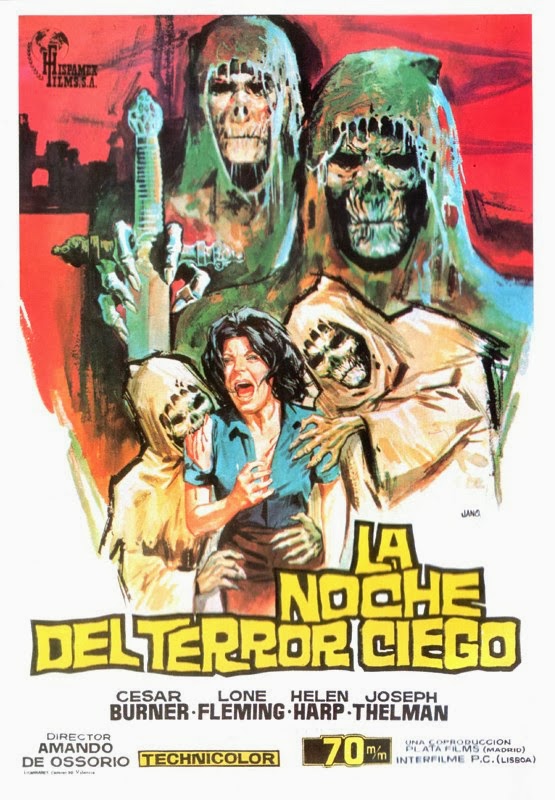
Poster for the original Spanish theatrical release.

THE INCREDIBLY STRANGE CREATURES WHO STOPPED LIVING AND BECAME MIXED-UP ZOMBIES!!? (1964)


A young man (director Ray Dennis Steckler, operating under the alias of "Cash Flagg") wanders an amusement park midway and is hypnotically beguiled by a stripper whose fortune-telling sister further hypnotizes him, adds him to her growing army of mind-controlled "zombies," and sends him on a murder spree that ends in tragedy. Sounds simple, right? Well, that description does nothing to get across just how weird and dreamlike the ludicrously-named THE INCREDIBLY STRANGE CREATURES WHO STOPPED LIVING AND BECAME MIXED-UP ZOMBIES is. Though largely remembered for its long-assed title, the film is famed in the ranks of bad cinema for a number of legitimate reasons, but I would like to consider those perceived flaws as elements that render it a queazily-unique entry into the genre, and not just as a time-waster to be jeered at.

A reported budget of $35,000 wouldn't buy anyone much in terms of production values, not even five decades ago, so Steckler's independent effort had a hell of a lot stacked against it from the get-go. Yet, somehow the film's lack of budget works in its visual favor, with its cheap film stock lending the proceedings a squalid look that tonally evokes home movies taken in some bizarre parallel dimension only just out of synch with our own. Though not as good as either, the film has the same kind of eerie, off-kilter resonance as both CARNIVAL OF SOULS and ERASERHEAD, so a feeling of nervous dread permeates every frame, and I'm fairly certain none of that air is intentional. The film's rundown midway/boardwalk location also contributes much of this character, replete as it is with POV sequences shot on a careening roller coaster, crude animatronics of monkeys and clowns whose movements and recorded words are sheer nightmare fuel,  garish sideshow imagery and barkers shouting come-ons to curious, seedy gawkers ogling an assortment of rather dodgy showgirls. And speaking of those showgirls, the narrative has a particularly fractured aspect in that it frequently interrupts itself for several awful musical numbers that feature awkward choreography (the dancing duo of a tall Teutonic-looking guy in a Fred Astaire-style tux and a brunette who one would swear was a female impersonator is especially embarrassing to witness), garish costumes (one of which sports feather placement that gives the lead dancer's "area" the look of '70's bush as rendered by a drunk Dr. Seuss), and lyrics that stick in the viewer's head for all the wrong reasons ("Pied Piper of Love" has been known to randomly pop into my head, and when it does I become nearly homicidal), all introduced by an emcee whose attempts at humor are so utterly void of laughs that they could rightly be considered an exercise in dada. Again, the mind returns to ERASERHEAD, this time to its kinda/sorta musical number, "In Heaven Everything is Fine," only with several such performed-in-some-undefined-limbo moments padding out Steckler's creation's running time.

With this cornucopia of dreamlike/nightmarish elements dumping itself all over the screen, the plot, such as it is, is completely beside the point as the audience is subjected to what amounts to a visual tone poem broadcast from an alternate reality. The movie's intended goal of being a bona fide horror film does not gel, nor is its story of particular interest, yet it compels with its surreal, borderline-fever dream flavor. THE INCREDIBLY STRANGE CREATURES WHO STOPPED LIVING AND BECAME MIXED-UP ZOMBIES is certainly not for all tastes and it may not provide what most people consider to be entertainment worth sitting through, but I urge you to give it a chance for its morphine-esque daze, almost-perceptible sweaty/grimy odor, and dark amusement park mirror reflection of our mundane world. (And having a pitcher of stiff adult libations close at hand is recommended during viewing.)

Poster from the original theatrical release.

THE GIANT CLAW (1957)


A mysterious U.F.O. is sighted and disappearances of planes and their crews follow the sightings. Eventually the object is revealed as a gigantic, ravenous bird of extra-terrestrial origin and its rampage claims herds of cattle, more planes, a couple of trains, and people on the ground, but not even the might of the world's military can stop the creature, thanks to it possessing some sort of anti-matter force field. As the death toll rises, the horror kicks up several notches as it becomes clear that the colossal predator has chosen the earth as its nesting ground and it's ready to lay eggs...

While not a horror film per se, THE GIANT CLAW is definitely a monster movie, one very much in the classic 1950's mold of military-versus-gigantic-(FILL IN THE BLANK) flicks, and as such it's a serviceable time-filler. It's decent enough but not exactly the kind of film that would necessarily have been remembered after its era of release, if not for one element that has granted the movie both screen immortality and outright infamy in the annals of motion picture history. That element is the title creature, a would-be horror that instead of dread elicits howls of derisive laughter by virtue of its jaw-droppingly awful execution. The ginormous space-bird is brought to vivid life — though absolutely not in the way the filmmakers intended — via a marionette, and not just any marionette. 

The puppet in question is, simply put, quite possibly the most ridiculous-looking beast in all of cinematic monsterdom. That's certainly a lofty claim and there are many, many other contenders for that dubious distinction — the title character from ROBOT MONSTER immediately leaps to mind — but how does one beat a tatty marionette whose stiff movements are overshadowed by its long and scrawny neck, flaring nostrils (?!!?), stringy and balding crest/Mohawk, shrill squawk, and large googly eyes? Simple answer: one doesn't. I mean, just look at this thing:


I know, right? It fairly screams "Special effects by Billy!" And here's a better look at its "fearsome" visage:

Some sources say that the puppet was crafted by some cheapjack Mexican company but whatever the case, the monster completely scuttled all hope of the otherwise straight thriller being taken seriously by anyone who draws breath. 

And you really have to pity the actors. While shooting the movie, they obviously to emote in reaction to special effects that they couldn't see, so what they ended up with was a feature film in which they bring the requisite amount of 1950's military/scientific gravitas to what can fairly be described as "The Attack of the Kiddie Show Vulture Puppet from Outer Space," and therein lies the indelible beauty of THE GIANT CLAW. It's unintentionally hilarious to see about a half-hour's very straight-faced buildup to what we expect to be some kickass alien raptor the size of a battleship (as it's described in the film), only to have the rest of the film play out as a race against time in which military brass, a gung-ho pilot hero (Jeff Morrow), and a hot brunette scientist (the always sexy Mara Corday) must contend with a refugee from PEE-WEE'S PLAYHOUSE. (NOTE: Terry the Pterodactyl from PEE-WEE'S PLAYHOUSE was an infinitely better puppet.) All of this is presented with the same level of straight-faced seriousness and impending doom as one would expect from a production of MACBETH, and the juxtaposition of said somber tone with the antics of one of the sorriest special effects on record make this film a cult favorite and the object of an almost perverse fascination. If you're ever at a loss for something to add to your Netflix queue, add THE GIANT CLAW, kick back a few beers and smoke a couple of quality blunts with some like-minded friends, and you will not be disappointed. And in closing, here's a wee taste:


THE MANITOU (1978)


When ancient Native American sorcery meets the 20th century, it's time for some '70's-style psychedelia!

Semi-fraudulent psychic Harry Erskine (Tony Curtis) makes a good living by using his gifts to serve as a paid living horoscope for a clientele of dowagers in San Francisco, but his world is turned upside down when a dear old flame named Karen Tandy (Susan Strasberg) turns up on his doorstep and requests his aid. Understandably concerned, Karen has found that a tumor is swiftly growing on the back of her neck and all medical testing concludes that the growth is actually a fetus. Accompanying that startling revelation are instances of Karen repeatedly uttering a strange phrase in her sleep, the same phrase being spoken by one of Harry's aged clients who appears to be possessed (she does a ritualistic dance and floats two feet off the floor and down the hallway before she throws herself to her death down the apartment building's stairs), and the tumor actively defending itself from removal by controlling the scalpel-wielding hand of the attending surgeon and lethally manipulating a surgical laser in an operating theater full of physicians. 

Realizing that the issue of metaphysical rather than mundane illness, Harry enlists the aid of fellow spiritualists who point him toward Native American shaman John Singing Rock (Michael Ansara, aka Kang from STAR TREK and former husband of I DREAM OF JEANNIE's Barbara Eden), who informs Harry that the tumor is in actuality the spirit — or "manitou" — of Misquamacas (Joe Gleb), a 400-year-old shaman who seeks to once more become corporeal so he can visit righteous vengeance upon the white man for the long list of atrocities committed against the red man. This Misquamacas is a spirit commanding vast maleficent power and he's extra pissed-off because the X-rays used to examine him have warped his regenerating form, rendering him stunted and hideous, so Harry and Singing Rock have their hands seriously full in a race against time to both stop the ancient horror and save Karen before Misquamacas's regeneration kills her. (Plus, not to mention the fact that the fate of the nation hangs also hangs in the balance.)

Misquamacas reborn.

Even five years after all the hoopla, THE EXORCIST remained a viable go-to film to attempt ripping of in hope of cashing in on the "devil junk" zeitgeist that swept the country at the time, and THE MANITOU, though not the flagrant knockoff that many of its contemporaries were, definitely fit the bill. It also added a little extra spiritual spice by throwing Native American mysticism into the mix. The acceptance of and interest in non-Judeo-Christian spiritual/mystical thinking and practices that flourished with the counter-culture movement of the 1960's carried over into the 1970's, which also coincided with all manner of paranormal freakiness, cryptozoological mania, and even the martial arts boom — which engendered curious embracing of Asian "mumbo jumbo" — as well as the re-discovery of the works of pulp horror writer H.P Lovecraft and his concepts of shapeless horrors so vast and terrifying that the mere thought of them would drive mere mortals stark raving mad. Thus,  THE MANITOU and its Mulligan stew of those elements and influences would have been perhaps the perfect distillation of post-EXORCIST 1970's horror...had it not been the baby of hack director William Girdler, the man who gave us DAY OF THE ANIMALS, ABBY — the infamously awful  blaxploitation clone of THE EXORCIST — and the cheesy JAWS ripoff that was GRIZZLY (1976). Working from a novel by U.K. horror novelist Graham Masterton, Girdler crafts a film that looks, feels. and plays out like a '70's-era made-for-TV movie, which is unfortunate because the ideas it presents are simply too grand for a film of its meager means. Though its setup is rife with potential, the film takes a very long time to get going and has such a made-for-TV flavor that its scene transitions seem ready to flow right into commercial breaks. (In fact, I dare say the film got more attention after its initial theatrical run in perpetual rotation on local TV stations than it ever did in theaters, so that aspect is somewhat ironic.)

However, it's not a total loss. Slow-moving though it is, and possessing a climax that almost seems like a tossed-off afterthought, the narrative does have a sweet love story between Harry and Karen that reveals the psychic to be a man of deep feeling and concern for his lover, so we do care about him and his quest. Michael Ansara's also fun as a late-20th century shaman, and the script has the decency not to make him just another rote "noble savage" stereotype. But to me the most interesting thing about THE MANITOU is its Lovecraftian aspect, including the concept of a formless and very evil "great old one" that backs Misquamacas, and the moment when the disappointingly brief showdown between good and evil manitous goes cosmic, causing Karen's hospital room to become a doorway to some sort of infinite void that exists in a dimension apart from our world. The imagery of her bed floating in a limitless star-field while within a hospital room is quite trippy, and the idea of the the manitous found in machinery being channeled through the body of Karen, thus also evoking primal female magic, is both intriguing and right in line with some of the areas of mysticism being popularly explored at the time of the film's release. 


Karen goes cosmic (and topless).

But no amount of good ideas can fully win out when trapped in a film that is otherwise governed by mediocrity. THE MANITOU is worth sitting through as an acceptable time-waster and is fondly remembered, and perhaps even beloved, by many who saw it during their childhoods, but it comes up rather lacking when seen from an adult perspective in 2013. See it for the sake of completism if you must, but you won't really miss much if you opt to skip it. 


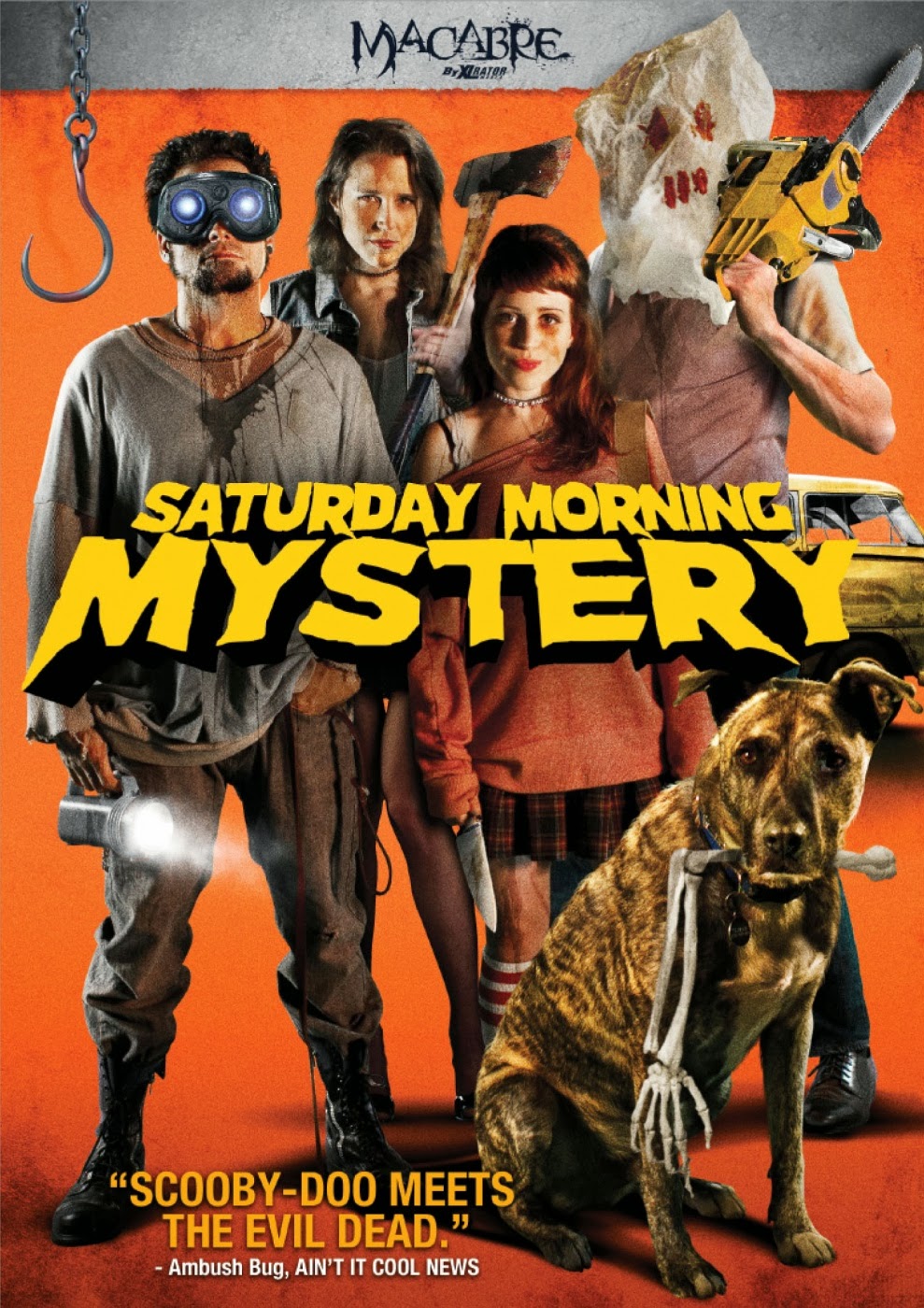
Poster for the theatrical release.

SATURDAY MORNING MYSTERY (2012)

Rather than simply go over old movies for this annual horror overview, I sometimes take a chance on a more recent fright epic and I'm sad to say that with the indie film SATURDAY MORNING MYSTERY, which originally saw limited independent release as SATURDAY MORNING MASSACRE, my curiosity bit me on the ass. WARNING: HERE THERE BE SPOILERS!!!

Working from a great idea, specifically a dark parody of SCOOBY-DOO for grownups that takes on all of the beloved Saturday morning cartoon's tropes and runs with them, the film gives us the basic familiar template of a group of young paranormal investigators — hot chick, brainiac girl, stoner, big dude who drives their van — and their big dog, roving about and solving mysteries that at first appear to involve ghosts, assorted monsters, and even aliens, but that are invariably revealed to be the work of senior citizens scam artists, petty criminals, and filthy perverts who try to scare people away from their illegal enterprises by faking the supernatural. After getting dressed down by cops whose months-long investigation of a kiddie porn ring is undone by their well-intentioned efforts, the dejected gang are offered one last shot at a real case when a banker calls to enlist their services in checking out a haunted house that his bank is trying to sell. The problem is that all of the repair crews and cleanup people who are hired to fix the place up keep refusing to do the work because the house is apparently haunted for real, so the investigators camp out there overnight, setting up cameras and generally checking the place out in hope of finding a real haunting for once. Let's just say that they get a lot more than they bargained for.

With its tone initially established as a straight-up humorous parody, SATURDAY MORNING MYSTERY almost immediately jettisons that angle and instead devolves into borderline-BLAIR WITCH PROJECT histrionics and dysfunction among its characters, while dragging the proceedings out interminably during its seeming eternity of an 88-minute running time. The alleged parodying of SCOOBY-DOO swiftly amounts to zilch as the characters fall victim to a jug of water that's laced with a considerable amount of LSD that the stoner hid there during an encounter with a friendly cop, and once within the house the tone shifts to full-on psychological/emotional drama as the foursome navigates the less-than-smooth waters of their assorted relationships, with only the dog coming out of it as pure and blameless. The first hour of the film is devoted to tons of boring talk covering that bullshit, an acid-induced semi-kinky sex scene that merely pads things out, and much shrill annoyance from the narrative's Velma stand-in (who's nowhere near as cool as Velma, by the way). And when things finally do start happening, it's revealed that the presumed ghosts that are haunting the house are actually a pair of feral kids who have turned the edifice's under-areas into the type of creepy, cluttered madhouse common to this type of yarn since THE TEXAS CHAIN SAW MASSACRE (1974), so the investigators still don't get a real haunting, despite all the setup that goes out of its way to establish things as such, thus screwing both the characters and the expectant audience in the process. That twist would have been quite clever had it been included in a genuine parody that stayed true to its espoused intent from the beginning, but this is a film that has no cohesive idea of just what it wants to be, so the characters and the audience are boned from the get-go. There are even a couple of gory murders — the axe beheading of the Freddie stand-in being a welcome highlight, though quite brief — so there are no guarantees that any of the characters will survive, including the dog, but it's all far too little too late.

Bottom line on this one: SATURDAY MORNING MYSTERY possesses a great concept but is inevitably a massive disappointment by virtue of its tonal schizophrenia, brontosaurus-on-Thorazine pacing, and utter failure to get the viewer to care about the characters, a quartet (plus dog) whose presumed interest is based on over four decades of their templates being familiar to us due to their now-indelible presence in pop culture. In this case, more was needed for these characters than mere sketches assuming our knowledge of the archetypes and the tropes that their adventures created. A lot more. Save your time and money and sit through something like PIECES again. That one's no classic either, but at least it's entertaining.

THRILLER: A CRUEL PICTURE (1973)

Originally published in 2009. Pixieish Christina Lindberg as Frigga, perhaps the ultimate put-upon exploitation movie heroine. When Sweden...