Thursday, May 15, 2025

VAMPIRE CIRCUS (1972)

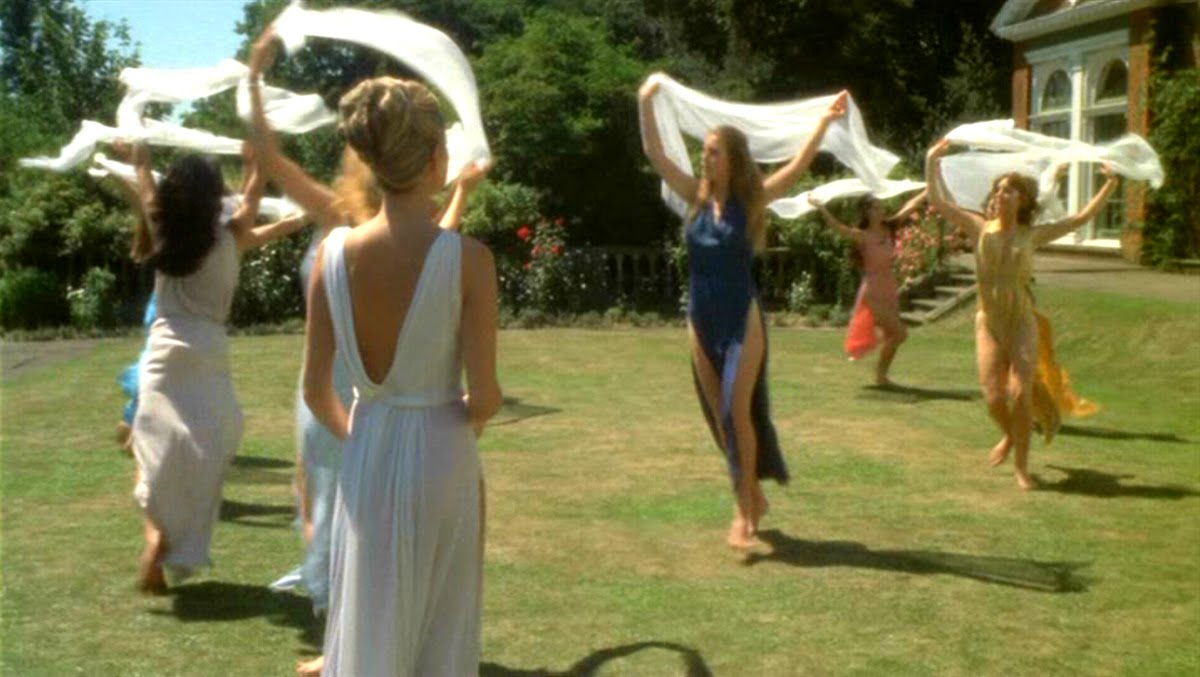
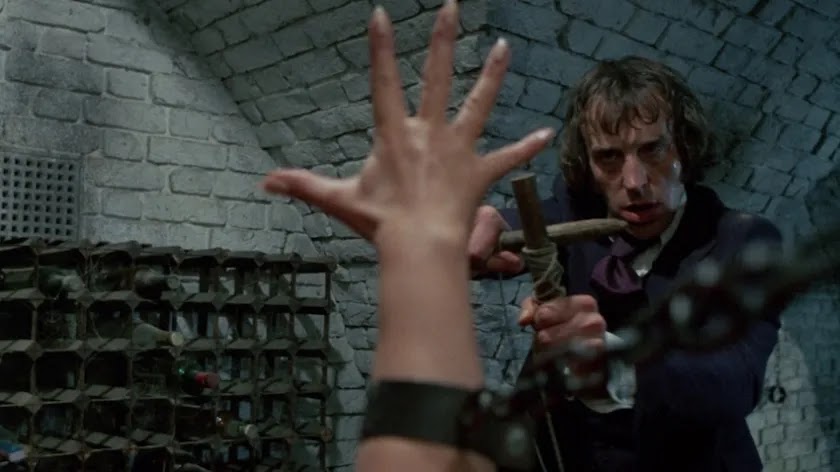
The Serbian village of Stetl is home to the vile Count Mitterhaus, a vampire who preys on young local girls for sustenance while sating his baser desires with Anna (Domini Blyth), the nubile wife of schoolmaster Albert Müller (Laurence Payne) and the vampire's very willing lover. 

                                         Evil for evil's sake: Count Mitterhaus (Robert Tayman).

Müller, fed up with the serial decimation of female youth (plus to say nothing of his being cuckolded by an undead suckface), rallies the village's men and leads a raid on the Count's castle, interrupting him in the midst of a lusty romp with Anna. The ensuing battle sees the deaths of a few of the men, but Albert drives home the needed stake through the heart. As his unnatural life force ebbs, the Count curses the village men, their children, and the viallge itself to death while Anna is scourged by the townsfolk. Even though she betrayed him for another man, er, vampire, Albert calls a halt to the beating, allowing Anna to flee back into the castle, which is promptly put to the torch by the rabble. But, unseen by the incensed villagers, Anna hauls the Count's body into then depths of the castle, where, with his dying breath, he instructs her to contact the Circus of Night, specifically his cousin Emil, who will "know what to do." As the castle burns, Anna flees the scene. Fifteen years later, Stetl has been closed off from the rest of the world as it is wracked by a deadly plague, a disease believed by men of science to be a pandemic, but what is in actuality part of the Count's curse in dread action. Into this bleak tableau arrives the caravan of the Circus of Night, featuring an eerie assortment of performers, all of whom are vampires, shape-shifters, of other creatures of indeterminate nature.

What we get with VAMPIRE CIRCUS is a well-mounted but middling effort that reveals the once-groundbreaking and relevant Hammer studios on its last legs, a brand done in by changing times and the permissiveness wrought by the 1960's and early-1970's. Where Hammer had once been a trendsetter with its then-shocking amounts of gore and saucy sexual content, international works had over the course of a decade eclipsed them with what filmmakers could get away with. The splashes of bright Sherwin-Williams red paint that stood in for blood now looked quaint and tepid when compared to the gore-fests of the like of Herschel Gordon Lewis and the nudity now found in European releases rendered Hammer's tight bodices and generous, heaving bosoms passe, so in order to compete Hammer upped the gore and grue, and the nudity moved well past the occasional mouthwatering decolletage into the realm of frequent toplessness, nekkid ass, and minor glimpses of bush, all at the expense of narrative quality. Hammer's stock in trade had been the Gothic made palatable to the masses, telling those stories with genuine suspense, lavish production design, a signature flavor and sound, and frequent reinvention of horror tropes that had been long established, most notably by the Universal monster cycle of the 1930's and 1940's, but the audience of the Civil Rights and Vietnam era were more sophisticated, having been exposed to the real-life horrors of the social unrest and military conflicts in clear representation in footage broadcast on the nightly news. Horror grew up in the 1960's, along with its audience, so the fare became harder-edged and more nihilistic, so Hammer's "Grimm's fairy tales for grownups" were a casualty of that evolution.

VAMPIRE CIRCUS, while not bad by any stretch, plays like what it is, specifically a catalog of Hammer vampire movie tropes, minus the creative spark that made their vampire efforts so memorable. It possesses a certain amount of atmosphere, but by the time of its release nearly every one of its aspects is as familiar as a beloved old cat that's getting on in years and clearly does not have long before the inevitable. The only new wrinkle in this is some of the bizarre performers in the circus (including a pre-Darth Vader David Prowse), but they are not all that well-realized. Yes, this was a last gasp and it showed. 

                      A pre-Darth Vader David Prowse takes a shotgun blast...and keeps on coming.

 If you ask me, the final Hammer piece that displayed real inspiration was 1974's CAPTAIN KRONOS, VAMPIRE HUNTER, after which the studio hobbled along until ceasing production in 1979. The company had enjoyed over two decades of trend-setting, beginning with THE QUATERMASS X-PERIMENT (1955), and kicking off proper with THE CURSE OF FRANKENSTEIN (1957), and HORROR OF DRACULA (1958), with many worthy films following in their wake and adding up to an impressive legacy. If you love the Hammer brand (when it's firing on all cylinders), then by all means give VAMPIRE CIRCUS a look, but don't anything particularly engrossing or all that fresh. It's an okay way to kill 87 minutes, but that's about it.


Poster from the theatrical release.


THE CURSE OF THE WEREWOLF (1961)


Oliver Reed, on any given day at the pub. 

Spain, the 18th century: On the wedding day of a cruel nobleman, a pitiful beggar (Richard Wordsworth) arrives at the nobleman's castle and begs for food. Much to the amusement of his equally assholish guests, the marques (Anthony Dawson) humiliates the beggar for sport and commands him to behave like a dog to earn table scraps. As the marques and his blushing bride leave the feast for the nuptial bed, the beggar makes a risqué comment that offends the nobleman, thus earning him a one-way ticket to a dank dungeon, where he is promptly forgotten (though regularly fed) and allowed to languish for fifteen years. In the meantime, the marquis has aged into a physical state as repellent as his overall personality and his wife has apparently died, so he sets his lecherous eyes on the mute, busty daughter of the castle's jailer, and when the girl (Yvonne Romain) rejects the vile old bastard's advances he has her thrown into the cell with the forgotten prisoner. 


The start of a VERY bad day for an innocent, mute serving girl (Yvonne Romain).

The prisoner, having been there for so long, has lost all semblance of sanity and is now a disgusting, hairy, feral mockery of humanity, and once the luscious girl is within reach he savagely rapes her — thankfully off-camera, but there is no doubt as to what's taking place — and the poor girl cannot even scream for help. His last energy spent during the violation, the beggar expires, and on the following day the girl is sent to the marquis' bed chamber, presumably chastised by her night in the dungeon. She instead gives the marquis the murder that he so richly deserved, after which she escapes into the nearby woods and nearly perishes in the elements. Found by the wealthy and kindly Don Alfredo Corledo (Clifford Evans) and his motherly housekeeper, Teresa (Hira Talfrey), she is nursed back to health and it is soon apparent that she has become pregnant by the feral rapist. Tragically, the girl only lives long enough to give birth to a son on Christmas Day, whom Don Corledo raises as his own. Since a child sharing the birthday of Jesus is “an insult to heaven” and said child is likely to be cursed as a werewolf, the boy, named Leon, is doomed from the start, and as he grows up he exhibits behavioral and physical traits that mark him as a lycanthrope in the making, and when he reaches manhood, his animal passions become ever harder to control, and he falls in love with a girl betrothed to another…


Young Leon's curse begins to manifest.

My love of Britain's wave of genre-redefining horror from Hammer Studios is well-documented and second only to my adoration of the classic Universal cycle of the 1930's and 1940's, but I only recently realized that I had neglected to discuss Hammer's sole werewolf outing in any real detail. That said, while I find several elements in the film to be very strong, I'm going to commit Hammer fan heresy and go on record to state that I find THE CURSE OF THE WEREWOLF to be something of a well-crafted letdown. Allow me to explain.


The adult Leon (Oliver Reed), rocking the superb work of makeup artist Roy Ashton.

Oliver Reed is perfectly cast as the brooding, tormented Leon, and the film allows us to get to know and understand him and his plight, which is only made worse when one considers the circumstances of his conception and birth. Like the best of protagonists who suffers the lycanthropic affliction, the audience's sympathy is firmly with Leon, but, like most of the rest of his accursed kind, his tragic end is pretty much a foregone conclusion and the narrative is pretty much a question of how to keep things interesting until the inevitable at the climax. The story is rock-solid up through and including Leon's curse starting to manifest, but when it skips ahead a few years to show us adult Leon, it turns into a period melodrama with no actual werewolf action until the very last reel, and what we get of that amounts to a rather minimal rampage until he's put down with the requisite silver bullet. The werewolf's mayhem is good for its era and the savage-looking makeup work on the creature itself are terrific, but it comes as too little too late, if you ask me. And as this was Hammer's sole werewolf movie, perhaps they didn't deem the werewolf to be as easily continued as the long runs of the Dracula and Frankenstein franchises.

Worth seeing, as Hammer's one shot at remaking another classic monster for the then-current time, THE CURSE OF THE WEREWOLF may not live up to its potential but it's certainly not a total loss. Tragic all the way and riveting during Leon's origin story, what's most interesting to me about all of it is that Leon’s troubles come not from being bitten or from some Satanic pact, but from the fact that little baby Jesus apparently has birthday attention issues.


Poster from the U.K. theatrical release.


LUST FOR A VAMPIRE (1971)

Mircalla strikes.

1830: At a girls' finishing school in Styria, new student Mircalla (Yutte Stensgaard) turns heads and bewitches the local male population, as well as some of her nubile classmates, and anyone who's ever seen a Hammer vampire movie will immediately peg the luscious blonde for what she is, namely an undead suckface. 

Just another day at finishing school.

Even more specifically, she's the resuscitated Carmilla Karnstein (the tragic protagonist of THE VAMPIRE LOVERS), and this time around she's head-over-heels in love with horror writer Richard LeStrange (Michael Johnson), who impersonates another teacher at the school so he can mack on schoolgirl tail. As the body count grows, so does the unnatural romance, which does not necessarily sit well with Mircalla's master, the evil Count Karnstein (MIke Raven).

Surprisingly NOT Chrstorpher Lee: Mike Raven as Count Karnstein

I first saw LUST FOR A VAMPIRE in an edited-for-TV airing sometime in the late-1970's and found it rather uninspired for a film from Hammer Studios. It bore a heavy cult reputation as the middle installment in Hammer's unofficial Karnstein "trilogy," largely due to it returning to the supernatural lesbian fan service previously explored in the previous year's THE VAMPIRE LOVERS  but seeing it again in 2018, LUST FOR A VAMPIRE comes off like an incredibly goofy self-parody. If a filmmaker set out to make an intentional sendup of the whole "lezzie vampire" sub-genre, this is the film that likely would result. It's not scary and its plot is downright silly, punctuated with gratuitous titillation and the unintentionally (?) hilarious "romantic" song, "Strange Love," which plays over a scene in which Mircalla and LeStrange get their hump on in a graveyard. That sequence elicited laughter from the audience at Manhattan's Quad Cinema during this past summer's Hammer retrospective, and several other moments in the film earned the same reaction.

A scene that would have been right at home on SCTV's "Monster Chiller Horror Theater."

As Hammer films go, LUST FOR A VAMPIRE is very much one of their weaker efforts, being pretty much by-the-numbers in every way, and it's definitely the installment of the Karnstein Trilogy that can be skipped. Admittedly, comparing it to the superb THE VAMPIRE LOVERS and the better-than-average TWINS OF EVIL (also 1971) is kind of unfair, but the truth is the truth and LUST FOR A VAMPIRE is only worth sitting through for the most die-hard of semi-erotic vampire yarn enthusiasts. And star Yutte Stensgaard is no Ingrid Pitt, that's for damned sure.

Poster for the American theatrical release.


THE SATANIC RITES OF DRACULA (1965)

                                                               Taking care of business.

 "The  Satanic Shite of Dracula," more like..

All good things must come to an end, and this film was one of the undeniable harbingers that Hammer's era of glory was well and truly over. As with  the previous entry, gone are the atmospheric Gothic sets and fog-shrouded forests and cobblestone streets, instead swapped out for the modern (translation: cheaper)  England, and with that loss the soul of Hammer bit the  dust.


Dracula (Christopher Lee) commands the audience to pull his finger.

For his last turn as Hammer's Dracula, Christopher Lee is given a dire script in which an apparently suicidal Dracula presides over a Satanic cult while seeking to take out humanity via a  super-powerful version of the bubonic plague whipped up by a biochemical  engineer in his  thrall. Peter Cushing's Van Helsing is along for the ride, but at  this point its all a case of too little too late.

A rarity in one of these films: an Asian vampire of the European variety (as opposed to the Chinese jiāngshī, of hopping vampire)

THE SATANIC RITES OF DRACULA is as lifeless as its titular character and could easily be ignored altogether if not for its historical position as  Lee's final outing in the role that made him an international star. An ignoble fate for the count, but it is what it is.

When you are bereft of ideas, it's time to break out the tiddies.

And wwith that we close out this year's 31 DAYS OF HORROR essays. See you next year and HAPPY HALLOW\WEEN, o my fellow Cine-Miscreants!

Poster for the U.K. release.


DRACULA A.D. 1972 (1972)


In 1872, Count Dracula (Christopher Lee) and his arch-enemy, Lawrence Van Helsing (Peter Cushing) engage in final combat, resulting in Dracula being fatally impaled on the spoke of a wagon wheel of the couch the pair battle upon. 


Van Helsing also perishes, but one of Dracula's followers — Seriously, why would anyone follow that bastard of their own volition? — retrieves the Count's remains and inters them near Van Helsing's grave at St, Bartolph's Church in England.

Oh, those wacky kids of early '70's London...

Fast forward by 100 years, to a London just exiting the swinging Sixties and now wallowing in the grooviness on the early 1970's. Jessica Van Helsing (Stephanie Beacham), granddaughter of Lorrimer Van Helsing (Peter Cushing again), attends a hippie-populated party where she meets Johnny Alucard (Christopher Neame), who appears to be the person who spirited away Drac's remains a century previous.  Alucard convinces Jessica and her friends to join him at the abandoned, deconsecrated St. Bartolph's Church, and if you have been paying attention during all of the previous entries in Hammer's Dracula franchise, you know exactly where all of this is going. Unfortunately, this is the point where Hammer's Dracula run, which had been teetering on and off for a while, finally gives up the ghost and plunges headlong into inescapable bad sequel territory.

Kensington gore and Caroline Munro as an altar: two great tastes that taste great together.


First of all, one of my pet gripes when it comes to vampire movies in general and Dracula movies in particular is when the writer's haul out the "Alucard" alias and think that it's clever. That one has been tired since Universal deployed it for SON OF DRACULA, and as of that film I have taken the use of "Alucard" as a harbinger of dire cinematic proceedings. This film's "Johnny Alucard" is unintentionally hilariously over the top, and he made me laugh out loud whenever he did or said pretty much anything. He's ridiculous and made me want to see what he got up to, but his presence can't have been intended to be as silly as it ended up being.

Say what you want for the rest of this misbegotten film, but Christpher Neame's turn as "Johnny Alucard" is a classic bit of unintentional (?) camp.

Second, while it was becoming clear that the times were a-changing and the once-edgy signature Hammer flavor of Gothic locales, heaving bosoms, and lashings of "Kensington gore were being rendered old hat by the more extreme horror entries from all over the world. The horrors of Vietnam and the Manson Family murders being broadcast on the nightly news opened our eyes to true hideousness, so Hammer's flavor was destined to be seen as quaint in the wake of ultra-nasty horror fare such as BLOOD FEAST (1963), 2000 MANIACS (1964), and THE LAST HOUSE ON THE LEFT (1972). Since Gothic was out, perhaps switching settings then-modern day London seemed like a good idea, but in no uncertain terms that creative decision drove a stake through the heart of Hammer horror and doused the corpse with a gallon of holy water.

I suppose most of the cast was game enough, but not even the presence of Peter Cushing, returning to the Dracula fold after too long an absence, and the lovely Caroline Munro save this from being a rote and instantly-dated attempt at being "down with the kids. And Christopher Lee, while always welcome as Dracula, looks visibly bored throughout.

"Do you like my ring? You can have it if you let me out of this turkey...

That said, the worst was yet to come...

Poster for the U.K. Theatrical release. Even Dracula looks goofy...


TASTE THE BLOOD OF DRACULA (1970)

      Drinking Dracula’s Kool-Aid. "Oh,YEEEEEAAAH!!!"

Three respected philanthropists seek fulfillment via debauchery in their off-time, becoming quite jaded in the process. 

 Pussy or a deal with the Devil? You decide!

During one of their nights at a favorite brothel, they meet young Lord Courtley (Ralph Bates), who was disinherited by his family for dabbling in the black arts. Courtley offers the debauched trio unprecedented experiences if they purchase from him artifacts of Count Dracula, including the vampire lord's dried blood, which will be mixed with Courtley's own blood and consumed in a black ritual. The gentlemen attend the ritual in an abandoned church, but all refuse to drink. Courtley, however, does drink, screams, and falls to the floor, grasping at his guests for help. Instead they stomp him to death and head for their homes, shaken by the whole sordid affair. Courtley's body of course transforms into Count Dracula (Christopher Lee), who vows vengeance upon those who murdered his servant.

                                                 Christopher Lee once again dons the cape.

TASTE THE BLOOD OF DRACULA may have been the first Christopher Lee Dracula movie that I saw during childhood, during a late-night airing on NYC's Channel 5, and at the time I thought it was pretty good. Christopher Lee was an imposing figure as the Count, and the idea of a ritual involving imbibing what amounts to "Dracula Powdered Drink Mix" was intriguing, but pretty much everything else about this one is about as rote as it gets. It's a load of same old-same old with the expected murders and seductions and a pair of uninteresting lovers thrown into the mix, and while nowhere near as dire as what would come next in the cycle, this one's pretty skippable. 

Poster for the theatrical release. The campy tag line does not help matters.


SCARS OF DRACULA (1970)

During last year's run of 31 DAYS OF HORROR, one of my goals was to cover all of Hammer's Dracula series, but it turns out that I neglected one of them. I knew I had seen all of them, most quite recently at the time, but upon reviewing all of the entries I noted that SCARS OF DRACULA slipped my mind. I watched it again the other day by way of a refresher, and I now understand why I forgot about it. It's not bad by any means, but for what one expects from a Hammer Dracula film, it's well-mounted but utterly generic. It reads as a how-to guide for how to construct one of these shockers, with only a few elements being true highlights.

Count Dracula has been destroyed and his desiccated remains lay atop an altar in an impenetrable tower of his castle. A puppet bat arrives and pukes blood onto the pile of ashes where the Count's head would be, and in no time Christopher Lee is back as cinema's most majestic and imposing iteration of Bram Stoker's arch-villain. He of course immediately embarks on slaughtering hot, bosomy young women, so the local villages take up their torches, pitchforks, and a good amount of highly combustible fuel and storm the castle. There they encounter Dracula's slave, Klove (well-played by Patrick Troughton, best known as the second Doctor on DOCTOR WHO), who tries to keep the throng at bay, but his efforts are unsuccessful as the villagers torch the castle. Dracula, however, is untouched by the conflagration, and he immediately revenges himself upon the townsfolk by slaying all of the town's women, who thought they were safe by being sequestered in a church.

Meanwhile in another town, studly young rakehell Paul Carlson (Christopher Matthews) is falsely accused of rape by the mayor's nubile daughter when he opts to leave her very welcoming bed to attend his brother's fiancee's birthday party, so Paul flees the home of the irate mayor (which allows us generous glimpses of his daughter's juicy bare backside) with the constabulary hot on his heels. He drops in on the party, only for the fuzz to arrive, so he escapes out the window and into a convenient carriage. The carriage bolts off without a driver, eventually coming to a halt in the town plagued by the count. It's just after dusk so Paul seeks refuge at the tavern owned by the leader of the torch-wielding peasants. He is gruffly turned away, only to wander into the nearby woods and find a driverless coach. Paul boards the coach and falls asleep, but the coach is not driverless. It's driven by Dracula's slave, Klove, and upon arrival at the ruined castle, Paul is greeted by the Count and Tania (Anouska Hempel). He is shown to a room and given lodging for the night, but Paul is soon visited by a clearly terrified Tania, who states that she is both Dracula's mistress and a prisoner, and she begs Paul to "love" her. Paul, knowing a good thing when he sees one, obliges and eagerly puts the bone to Dracula's sex slave. When the rumpy-pumpy is over, Tania attempts to put the bite on Paul — I'm impressed that she enjoyed his attentions enough to wait until after to do the undead suckface thing — but Drac bursts in and, none too pleased, savagely stabs Tania repeatedly with a dagger. 

The Count gets uncharacteristically stabby.

While Paul is relegated in one of the tower's inescapable rooms, Klove dismembers Tania body and dissolves its components in a tub of acid.

Paul's utter stiff of a brother, Simon (Dennis Waterman), sets off in search of his ne'er-do-well sibling with chaste fiancee Sarah (Jenny Hanley) in tow, and in no time they make their way to the hostile pub from which Paul was turned away, and they make their way to the Count's castle. You can guess the rest.

Paul: Hanging around in Dracula's tower. 

Other than some very alluring women in the forms of the mayor's cheeky daughter, a very friendly tavern wench (who tried in vain to warn Paul away from going to the castle), and the horny vampiress, the film is very much by the numbers, though Paul makes for a fun quasi-protagonist. He's more lively than damned near any other mortal male who finds himself crossing paths with Dracula (Van Helsing notwithstanding, but he's not present for this one), and he gets extra points for being an unrepentant poon-hound who beds a hot vampire and survives (though he does meet a nasty fate later on). Tania the vampire is a blend of the eerie, the alluring, and the tragic, and I genuinely felt bad when she got done in so cruelly. Klove is by far the most interesting of Dracula's slaves throughout the series, enduring some horrific cruelty from the Count yet being helpless to do anything other than serve him faithfully. 

Klove receives punishment by way of a red hot sword blade.

Unlike some of the previous entries, Dracula actually speaks a good deal in this one, which is always welcome as Christopher Lee is far more than just an imposing visual. We also get a bit cribbed straight out of Stoker, specifically the bit where Dracula is see crawling up the castle walls like a bat making its way to its nest. It's creepy as hell and I wish there had been other such bits to be had.

Like I said, SCARS OF DRACULA is not bad, but rather a case of "here we go again" with little new being put on the table. I first saw it during a late-night airing on New York City's Channel 5 one weekend when I was twelve and I liked it quite a lot. It may have been my first Hammer Dracula, and it was definitely a breath of fresh air from the less-visceral Dracula flicks from the times before the advent of Hammer's specific style and flavor, but it's definitely a mid-level entry among the Christopher Lee era. When it comes to the studio's Christopher Lee-led undead suckface movies. 1968's DRACULA HAS RISEN FROM THE GRAVE is by far the standout, with the non-Lee BRIDES OF DRACULA (1960) being perhaps the best of Hammer's Dracula franchise, so seek those out instead.

Poster from the original theatrical release.

DRACULA: PRINCE OF DARKNESS (1966)


The one and only Christopher Lee returns to don fangs and cape.

As promised, I am finally tackling the remainder of Hammer's Dracula films, so we begin with this, the third in the run and the second to feature Christopher Lee's indelible version of the Count.

Ignoring the existence of the superb THE BRIDES OF DRACULA, DRACULA: PRINCE OF DARKNESS picks up some ten years after the events of THE HORROR OF DRACULA, with Dracula well and truly extinguished from the face of the earth. Nonetheless, the locals who live near Dracula's castle retain their memories of what came before, and the fear and superstition remains. Into this scenario arrive four vapid British tourists (who are so nondescript, it's not really worth describing them as individuals) who stop at the town pub before making their way into the mountains. There they meet Father Sandor (Andrew Keir), a rifle-toting monk who urges them to stay at his monastery as opposed to venturing through an accursed area. The idiot tourists of course ignore his warning, and in no time they find themselves guests at what was once Dracula's domicile. The weird thing is that Dracula's creepy servant, Klove (Philip Latham) welcomes them as though they were expected, and they arrive to find everything in readiness for them as guests. Needless to say, Klove lures one of the men to his doom in one of the castle's secret rooms, where he hangs the guy by his heels over Dracula's open coffin and slashes his throat, allowing the blood to flow freely and revive the lord of evil (the aforementioned Christopher Lee).


Castle Dracula, where kosher meals are part of the service.

The Count kills one of the two remaining female tourists and turns the other into his very willing slave, so it's up to the remaining tourist and Father Sandor to come to the rescue and kick Dracula's ass.

"Actually, I am filled with candy!"

As entries in Hammer's legendary Dracula series go, this one is merely okay, and it is the first to underscore the fact that no matter how mediocre the script may be, Christopher Lee made for arguably the most imposing and menacing Dracula ever. There's no Peter Cushing to serve as a worthy foil in this one (alas), so all of the heavy lifting falls to Lee and he handles the task well. The rest of the characters are one-note, with Father Sandor being the only one of any sort of interest, and the vanquishing of Dracula at the finale is a bit of a letdown.

"Look both ways before you...CROSS!!!" (I'll show myself out...)
 
There are worse in Hammer's Dracula run — as you will see — but this one is kinda rote and can be sat through with the knowledge that what immediately follows in the series is quite a lot better, but we'll get to that soon enough...


Poster for the theatrical release.


CIRCUS OF HORRORS (1960)

The gravest show on Earth.  

I watched CIRCUS OF HORRORS (1960) in two installments, thanks to me falling asleep while watching it last night. It was in no way boring, I was just very sleepy, so I finished it a few minutes ago.

The story begins in 1947 and revolves around Dr. Rossiter (Anton Diffring), a renegade plastic surgeon in England who works miracles with a scalpel, but some of his early and illegal experiments leave some of his patients permanently disfigured and driven mad by their irreversible facial deformity. 
 
One of Dr. Rossiter's plastic surgery disasters.
 
Rossiter flees the authorities, running over and killing one while driving through a barricaded road, totaling his car in the process, but he makes his way to the home of his surgical assistants, a brother and sister team, and has them surgically alter his face. The trio then escape into France where Rossiter, now operating under the name Schuler, comes into possession of a failing circus when the previous owner (Donald Pleasance), in an act of financial desperation, signs over the rights to the circus to the surgeon, after which the former owner is mauled to death by a bear while drunk. Rossiter witnessed the incident and could have helped the previous owner, but he lets him die in order to have no possible resistance to his claim on the circus. He also takes over raising the dead owner's young daughter, whom he performed surgery on to fix the facial scars she suffered during the bombings of World War II.

Dr. Rossiter/Schuler and accomplices.

The story then skips ahead by a decade and finds the circus making money hand over fist under Schuler’s management. He staffs the circus with women he found on the street, prostitutes and criminals, all of whom had facial disfigurements that he fixes for free, and they then join his circus in various performance capacities, some of which are highly dangerous. The big top travels all over Europe and gains a reputation as “the jinx circus,” thanks to its female stars occasionally meeting grisly fates during their acts, so the potential of witnessing live death puts asses in seats and the public eats it all up. During all of this, Schumer has affairs with several of his performers, all of whom he beautified with his surgical wizardry, but when they express a desire to leave the circus or if they step out of line in any way, with the help of his male surgical partner he orchestrates their deaths during performances, always ensuring it looks like an accident. But the circus’s gruesome reputation catches the attention of a reporter who begins investigating the circus, a journalist who happened to have covered the Rossiter case ten years earlier and would love to see that case closed. His investigation leads him to deduce that Schuler is the vanished Rossiter, and as he gets closer to solving the case, the bodies pile up and Rossiter becomes more unhinged

Released a year after the not dissimilar HORRORS OF THE BLACK MUSEUM and the same year as the epochal PEEPING TOM and PSYCHO, CIRCUS OF HORRORS merrily doles out its sleazy thrills in a manner that was no doubt quite shocking to the British audience of its era. Hammer horror, with its “Kensington gore”and emphasis on femine pulchritude, was still a relatively new flavor, and its success guaranteed that other studios would imitate its lurid content. CIRCUS OF HORRORS look and feels like a grubby pulp novel brought to vivid life, and it’s a lot of fun. The kills are all telegraphed a mile away, but it’s a matter of building suspense until the inevitable happens, and getting there was quite nail-biting for its era.

The performances are all solid, and Anton Diffring is terrific as Rossiter/Schuler. And if you pay attention, you’ll notice that the cast features a number of soon-to-be-familar faces, including Donald Pleasance, Yvonne Monlaur (the heroine in Hammer’s BRIDES OF DRACULA), an uncredited pre-R2-D2 Kenny Baker as a circus dwarf, Yvonne Romain (best known as the mute servant girl who is raped by a feral dungeon prisoner and subsequently gives birth to a werewolf in CURSE OF THE WEREWOLF), and an uncredited Walter Gotell, who would later appear in seven James Bond films, first as the major domo of SPECTRE island, and then appearing six times as Soviet General Gogol.

Bottom line: CIRCUS OF HORRORS is solidly entertaining in ways that were sure to have outraged genteel British sensibilities at the time, but must have been a favorite among the more viscerally-inclined audience members. RECOMMENDED.

Poster for the theatrical release.


FRANKENSTEIN AND THE MONSTER FROM HELL (1974)

More fun with Baron Frankenstein.
 
Having survived the conflagration at the climax of FRANKENSTEIN MUST BE DESTROYED (1969), Baron Frankenstein blackmails his way into being the secret power within a mental institution, lording it over the alcoholic and lecherous head administrator and being allowed to treat the patients. Into this scenario is thrust young surgeon Dr. Simon Hedler (Shane Briant), a talented practitioner who seeks to follow in Frankenstein's footsteps by crafting a man from choice components and animating it. Hedler's pilfering of corpses and body parts is discovered and he is sentenced to a minimum of five years in a mental asylum, despite clearly not being insane. Fate lands him at Frankenstein's looney bin and in no time they develop a master/acolyte partnership, aided by the beautiful and mute Sarah (Madeleine Smith, late of1970's  THE VAMPIRE LOVERS), aka "the Angel," and Helder reveals an obsession with the secret of life that rivals his mentor's. 
 
The Baron, the Angel, and padawan.
 
From there it's pretty much what we have come to expect from a Hammer Frankenstein outing, as the Baron slowly lets Helder into his close circle of trust, revealing that he is once more attempting to create life from the dead, only this time garnering his choice parts from the remains of two inmates who expire under, er..."mysterious" circumstances, and using the hairy, hulking body of a homicidal "neolithic" throwback as the main chassis. Resembling a foul-tempered Sasquatch more than a human being, the creature (played by a pre-Darth Vader Dave Prowse) was once a man possessed of inhuman strength and a fascination with glass, which he enjoyed breaking and using to stab his victims in the face. The body, odd though it is, will do, but Frankenstein seeks the hands of an artist (that he lops off of the murdered body of an insane sculptor) and the brain of a genius (a professor of music and advanced mathematics, whose suicide by hanging via his own violin strings was prompted by the Baron making him aware that he would never be released, despite him only being locked up for something minor and curable), and once the Baron obtains them, the shenanigans begin...
 
Shopping for parts.
 
By the time FRANKENSTEIN AND THE MONSTER FROM HELL was released, it was pretty obvious that the writing was on the wall for Hammer, as their once-shocking brand was more or less rendered passe by the new permissiveness of onscreen sex and violence — which they had helped to usher in over the previous 17 years — and the flavors of horror shifting away from "adult fairytale Gothic" to outright festivals of carnage like BLOOD FEAST, 2000 MANIACS, and THE LAST HOUSE ON THE LEFT. To be honest, and I say this as a Hammer devotee, their best years had been behind them for a while and they had begun to run out of ideas as the 1970's dawned. But at least this final outing for the wicked Baron was a case of the Frankenstein series going out with a bang. There's no sex or nudity in this one, but the story is solid and the lashings of gore are quite vivid and satisfying. 
 
Back in 1974, this sort of thing got you an "R" rating.
 
The Baron is as evil and coldly aristocratic as ever, and it's a delight to see him reduce the hospital's sadistic and corrupt staff to fearful lumps of jelly when he takes them to task for their abuse of the patients. (Including serial torture and rape.) The Baron may be a bastard, but even he will not abide wanton cruelty inflicted upon the clearly helpless and mentally-unwell.

"Pikachu...I choose you!"

The monster is one of the most unique designs for the classic shambling abomination, and Dave Prowse acquits himself nicely with a role dependent more upon his gym-earned physical presence than the sparse amount of lines the creature is given. He's definitely a version of the famous creature that no one would ever want to tangle with, what with his super-strength and a mind that is subsumed by the body's natural propensity for mutilating people with glass...

The creature.

When it's all over, the Baron and his accomplices live to cause mayhem and blasphemous crimes against nature another day, with them set in place in their asylum base of operations should the series have continued, but such was not to be. 

As a final entry in a series that had run on and off for 17 years, FRANKENSTEIN AND MONSTER FROM HELL is a lot of fun, though certainly not up to the standards of some of the installments that preceded it. Nonetheless, it's a good entry-level shocker for the older monster kids. (If released today, this would earn a PG-13.)

Poster from the American theatrical release.


THRILLER: A CRUEL PICTURE (1973)

Originally published in 2009. Pixieish Christina Lindberg as Frigga, perhaps the ultimate put-upon exploitation movie heroine. When Sweden...