
"Once drawn by that merciless wind, the fair youth of morning is at
dusk naught but bones. In the end, all must die. Numberless are the sins
committed on the way to death. For those sins, there may be punishment
in the law. Some may slip through its net, but the awareness of sin
cannot be escaped. Religion imagines a world after death, dealing
punishment in place of the law. That world is Hell."
— opening narration
Theology student Shiro Shimizu (Shigeru Amachi) is engaged to Yukiko
(Utako Mitsuya), the daughter of his respected teacher, Professor
Yajima. He also maintains a strange relationship with the uber-creepy
Tamura (Yoichi Numada), who seems to know the intimate and sometimes
shameful secrets of all and sundry. Showing up uninvited to the
professor's house as Shiro announces his intention to marry Yukiko,
Tamura makes it clear to the professor that he knows of an atrocity that
the man committed during WWII and leaves with Shiro. As Tamura drives
Shiro home, Tamura lets on that he knows Shiro has been sleeping with
Yukiko and asks him to consider the possibility that she may be
pregnant. (The guy's a total buzzkill from the word "go.")
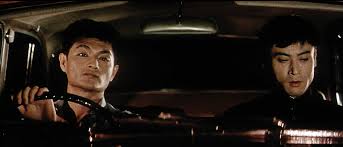
Tamura (Yoichi Numada) and Shiro (Shigeru Amachi), on a road trip to a dire destiny.
Seconds later, Tamura runs over a drunk named Tiger Kyoichi, a leader of
the Gondo yakuza syndicate, and drives away. Shiro demands that Tamura
stop the car so they can see if the victim is alright, but Tamura
stoically refuses and blames the accident on Shrio, citing that it would
not have happened if he had not asked Shimura to deviate from his
planned route of travel. While Shiro silently contemplates his
culpability for murder if the man dies, the gangster's mother (Kyoko
Tsuji), alongside his floozy girlfriend, Yoko (Akiko Ono), grieves over
her son's corpse and vows vengeance should she ever find the hit-and-run
perps. Upon reading of the hit-and-run in the paper the next day,
Tamura could not give less of a shit if he tried, while Shiro tries to
convince him to go with him to the police and turn themselves in. Tamura
notes that Kyoichi was only some piece of yakuza scum and not worth the
best years of their lives, but the guilt-ridden Shiro confesses the
accident to Yukiko, who suggests that her father might know what to do.
While on their way to see the professor, the cab the pair are riding in
crashes into a telephone pole and Yukiko is tragically killed. After
Yukiko's funeral, Shiro frets over whether he or Tamura will "win" their
battle of conscience (or lack thereof) and finds himself hanging out in
a sleazy nightclub, where he meets, picks up, and puts the bone to the
yakuza's bereaved girlfriend (who is also revealed to be a heroin
addict, in a narrative bid to up the vileness quotient). Yoko twigs to
the fact that Shiro is one of her lover's murderers, so she reports back
to the gangster's mother and, with the target now identified, the plot
for revenge escalates.
As if Shiro were not already fucked up enough by his fiancee's untimely
demise, he heads to a rustic retirement community upon being notified
that his mother if terminally ill, and while his mother lays there
slowly expiring, her husband cavorts in the very next room with some
kimonoed hoo-er. (Yeah, this movie's a roller coaster ride of
sunshine...) Suddenly, a cutie named Sachiko shows up and she happens to
look exactly like the dead Yukiko (which only makes sense, as she's
played by the same actress). Sachiko sent the letter that alerted Shiro
to his mother's illness, and she is his mom's nurse, as well as the
daughter of Ensai (Jun Otomo) an alcoholic painter who lives nearby and
drinks heavily while painting a depiction of Hell. We also meet other
assorted residents of the community, all of whom are quite sleazy and/or
pathetic, and are each responsible for murders and other acts of
awfulness in the past. Tamura, the professor, his wife, the yakuza guy's
mom, and the yakuza guy's lover all converge on the retirement
community and in short order all are killed, via natural death, suicide,
a fall from a great height, hanging, consumption of rancid fish and
poisoned wine at a party, gunshot wounds, or strangulation. Thus, every
fucking character in the story is consigned to Jigoku, which is the
Japanese word for Hell. Well most of them go to Hell, but I'm getting to
that...

When I first sat through JIGOKU — aka SINNERS OF HELL — I was
disappointed to discover that it's basically a slice-of-life drama
focusing on the sleazy doings of some Japanese folks in 1960 whose
climax features an infamous depiction of the culture's concepts of Hell
and what becomes of those whose vileness during life earns them a
one-way ticket to eternal damnation. Loaded with enough sleazy
characters and situations to fuel several schlocky soap operas, the
melodrama just keeps on coming, piling on atrocious behavior after
atrocious behavior with the kind of glorious excess for which Japanese
cinema is renowned. In fact, things get so over-wrought that it all
verges on self-parody. But the most bizarre aspect of this flick is its
dual nature as a two-way mind-fuck of a film. If one approached this
movie knowing absolutely nothing about it, it at first reads as a
straight drama picture, which is totally understandable, but then it
turns into a balls-out gruesome and gory festival of the torments of the
damned brought to life. It's like someone swapped out the last reel for
the ultra-nasty and surreal final twenty-plus minutes of an unabashed
horror movie.

Just one of the creepy images seen once the film quite abruptly turns into a straight-up horror movie.
Upon his death, Shiro ends up in Limbo, where he again sees Yukiko, who
tells him she was pregnant with his daughter, whose soul has been sent
along the river into the underworld, so Shiro must brave the horrors of
Hell itself to save her. What follows is a journey through hideous
punishments, tortures, and other such wholesome sights, coupled with a
few shocking revelations along the way. Packed with creepy and
gore-filled imagery, the Hell sequence features a cornucopia of folks
being graphically beheaded, sawn in twain, flayed, disemboweled,
tormented by naked temptresses, being boiled in oil, impalement,
tongues torn out, walking barefoot through a landscape of
three-foot-tall glass shards, and the general hopelessness of
existence.

Not even Hammer films went there like this back in 1960, so once again Japan delivers.
Even by today's standards, some of this stuff is very extreme and
disturbing, and it's worth making one's way through all of the soap
opera mishegoss just to get to it. That said, the ending is
simultaneously disappointing and corny, but the film overall packs
serious balls and must have been quite a shock to Japanese audiences in
1960. And if you're wondering why you've never heard of this movie,
despite there having been a ton of Japanese horror and sci-fi flicks
released in the States during the 1960's, trust me when I tell you that
this film's content did not have a hope in, well, Hell of ever getting
past American censors. Even without its visceral diabolical
slaughterhouse segments, the film's adult content would have been tough
for watchdogs of media decency to let by, and an edited version would
have ended up as a very short and incomprehensible mess.
Though its 100-minute running time may occasionally seem to drag a bit,
which has a lot to do with the film's utterly joyless/hopeless tone,
JIGOKU is never boring and the final reel makes it worth a look for all
horror completists.

Poster from the theatrical release.


No comments:
Post a Comment